Exploring Cairo and Alexandria offered a powerful contrast and a deeper understanding of modern Egypt. These are the country’s two great cities — one anchored along the Nile, the other stretching out beside the Mediterranean — each intense, layered, and unforgettable in its own way. Together, they showcase the scale, complexity, and spirit of Egypt, where ancient history and everyday life exist side by side, often in the most surprising ways.
Cairo is an absolute maze of humanity, home to well over 20 million people and somehow always in motion. The city feels endless, stretching far beyond what seems possible, alive at every hour with car horns, voices, and the constant flow of people through the streets. It never truly sleeps. And yet, woven into that chaos is some of the most extraordinary history in the world — from the timeless Giza Pyramids rising on the city’s edge to the quieter, deeply spiritual corners of Coptic Cairo. Cairo can feel overwhelming, but it’s also exhilarating, a place where the weight of history and the energy of daily life collide nonstop.
Alexandria, by contrast, felt more relaxed — though still unmistakably Egyptian. Set along the Mediterranean, the city carries a softer rhythm, shaped by sea air, coastal views, and its own blend of ancient influences. Greek, Roman, and Egyptian history surface throughout the city, balanced by long waterfront walks and plates of fresh seafood pulled straight from the sea. With its historic sites, cultural landmarks, and breathtaking Mediterranean views, Alexandria offered a slower, more reflective experience — a perfect complement to Cairo’s intensity. Together, these two cities capture what makes Egypt so compelling: chaotic and calm, ancient and alive, demanding and deeply rewarding to explore.
Cairo, Egypt
Cairo is a city that hits you all at once — loud, crowded, relentless, and completely unforgettable. Built along the Nile and home to more than 20 million people, it feels like a living maze that never sleeps, where the streets are always buzzing and life spills out in every direction. It was both the starting and ending point of my journey through Egypt, a fitting bookend to an adventure rooted in history and contrast. Amid the constant movement, Cairo holds an astonishing concentration of the past. From the timeless Giza Pyramids rising at the city’s edge to the vast halls of the Grand Egyptian Museum, the scale of Egypt’s ancient legacy is impossible to ignore. We traced even older roots at Saqqara and Memphis, where the earliest experiments in monumental architecture still stand, and stepped into the quieter, deeply spiritual atmosphere of Coptic Cairo, offering a powerful counterbalance to the city’s chaos. Visits to the Papyrus Institute highlighted traditions still practiced today, while wandering through Khan el-Khalili Bazaar immersed us in a sensory overload of lanterns, spices, voices, and centuries of trade. Overwhelming at times but endlessly fascinating, Cairo is demanding, exhilarating, and essential — a city that captures the raw energy and layered history that define Egypt itself.
Coptic Cairo: Where Faiths and History Intertwine
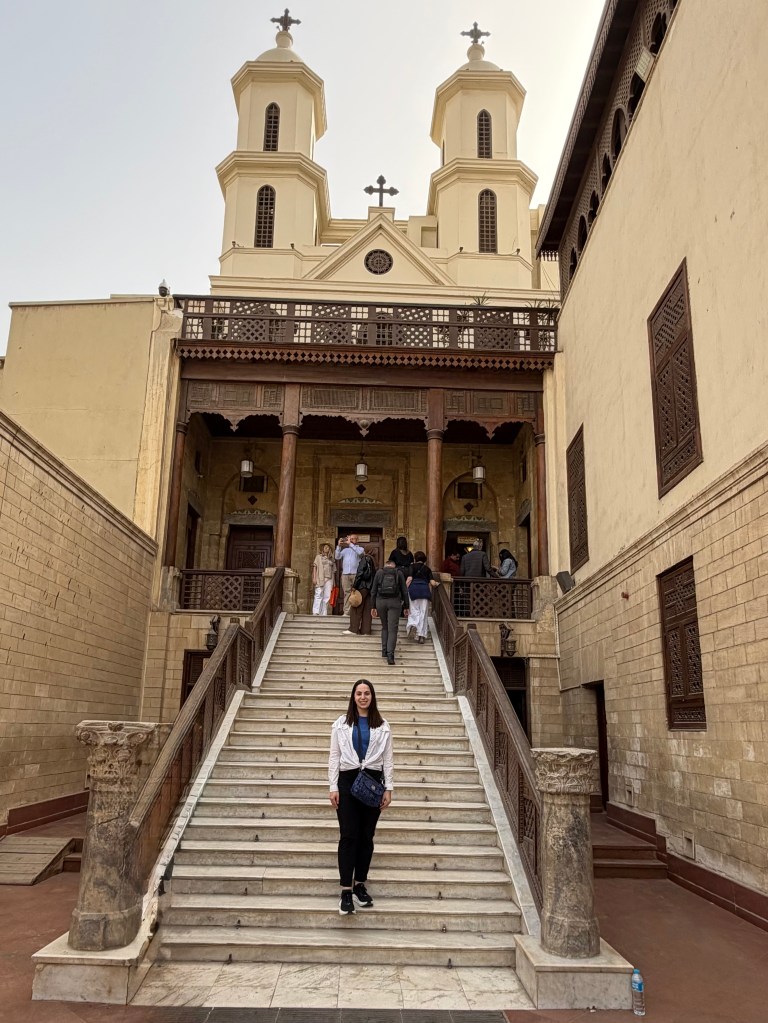
Coptic Cairo was the perfect way to begin my time in Egypt. On our first day, we explored an area where centuries of religious history coexist in a way that feels both powerful and humbling. Christianity, Judaism, and Islam come together here, not as distant concepts from the past, but as living, breathing parts of the city.
We visited Abu Serga (Saints Sergius and Bacchus Church), built above the cavern where Jesus and Mary are believed to have stayed during their flight into Egypt. Standing in that space was incredibly moving, a quiet moment that immediately grounded me in the depth of Egypt’s spiritual history.
Just steps away was the Ben Ezra Synagogue, which was both beautiful and fascinating. The architecture and history of the synagogue offered a glimpse into Cairo’s long-standing Jewish presence and added another layer to the area’s rich cultural tapestry.
We also explored the Hanging Church (Church of Al-Mu’allqa), a stunning Coptic church known for its elevated structure. I loved the peaceful courtyard, the warm brickwork, and the stained glass windows that filled the space with soft, colorful light. It was one of those places that made me want to slow down and simply take it all in.
Coptic Cairo felt like walking through a living timeline—one that set the tone for the rest of my journey in Egypt.
The Citadel of Saladin & the Mosque of Muhammad Ali
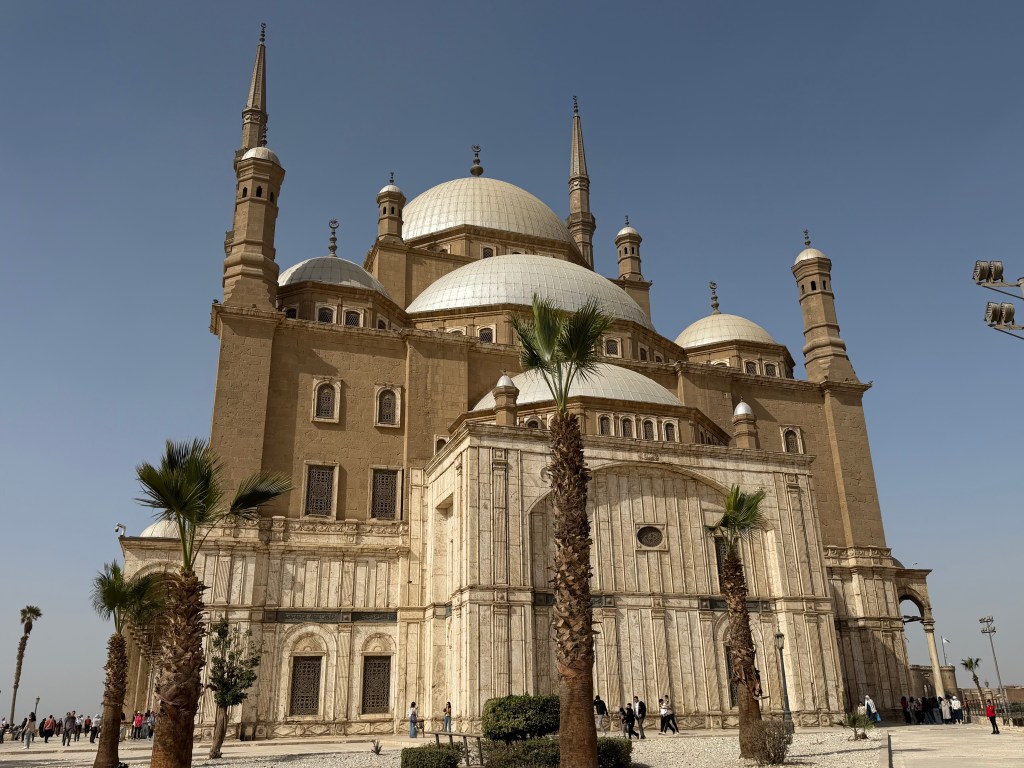
After exploring Coptic Cairo, we headed to one of the city’s most iconic landmarks: the Citadel of Saladin, a historic fortress that offers some of the best views of Cairo. Walking through the Citadel felt like stepping into another chapter of Egypt’s story, where power, religion, and architecture all collide.
The highlight of the visit was the Mosque of Muhammad Ali, often referred to as the Alabaster Mosque. From the moment I stepped into the open-air courtyard, I was struck by just how massive and grand the space was. The symmetry, scale, and calmness of the courtyard made it feel both powerful and peaceful at the same time.
Inside, the mosque was just as breathtaking. The enormous chandelier hanging from the ceiling immediately draws your eye upward, along with the intricate mural paintings that cover the domed ceiling. Every detail felt intentional and elegant, and the sheer size of the interior made me pause and take it all in. It’s one of those places where you can’t help but feel small in the best way.
Visiting the Citadel and the Mosque of Muhammad Ali was the perfect way to round out our first day in Cairo. It tied together everything I was beginning to understand about the city—its deep history, architectural beauty, and the way multiple cultures and faiths have shaped it over time.
Grand Egyptian Museum (GEM)
Visiting the Grand Egyptian Museum — also known as the GEM — felt like stepping into the future of ancient history. Officially opened in the fall of 2025 after years of anticipation, it is now the largest museum in the world dedicated to a single civilization. For decades, many of Egypt’s most important treasures were housed in the original Egyptian Museum in Tahrir Square. But as the collection grew and conservation needs increased, plans were set in motion to create a new, state-of-the-art space near the Giza Pyramids. The result is nothing short of extraordinary — a modern architectural masterpiece designed to honor one of the oldest civilizations in the world.
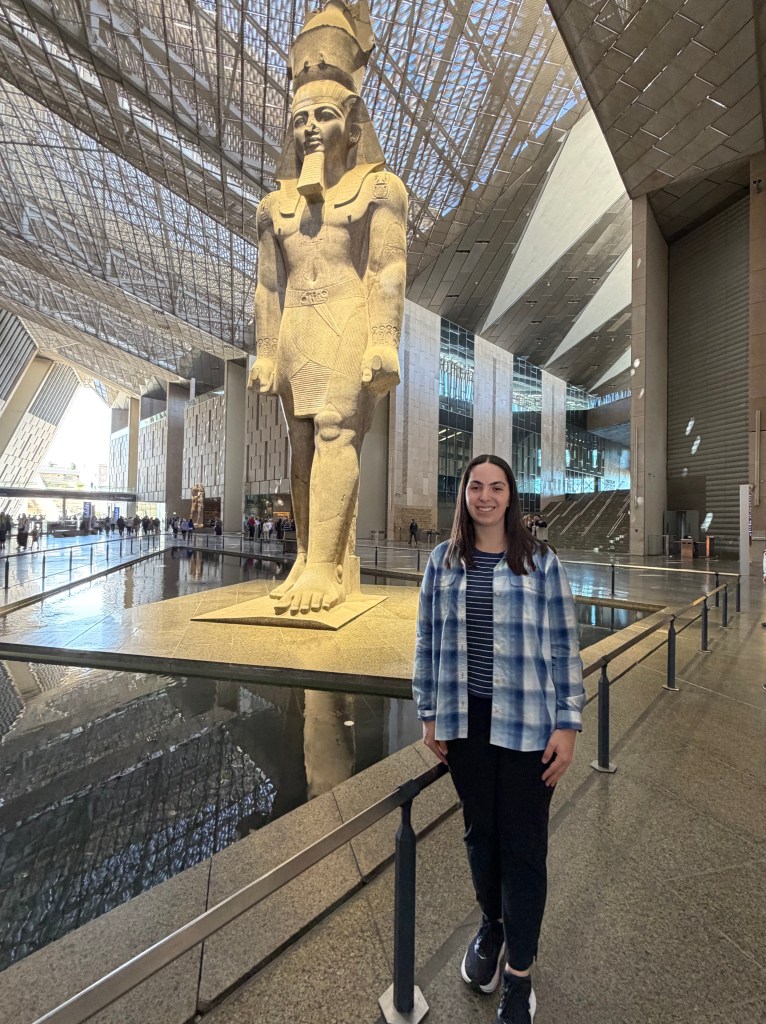
Even before entering, the scale of the museum is breathtaking. The triangular façade subtly mirrors the nearby pyramids, and the grand entrance — etched with hieroglyphics and framed by cascading water features reminiscent of a cataract — immediately sets the tone. It feels monumental in every sense. Walking into the main hall, the open-air concept and natural light made the space feel expansive yet peaceful. At the center, surrounded by shallow water, stood a colossal statue of Ramses II. Seeing him positioned there, almost as if welcoming visitors into his world, was unforgettable.
Leading up to the main galleries, we passed through a soaring hall lined with towering statues, massive stone columns, and artifacts from across Egypt’s long history. A grand escalator carried us upward, offering a bird’s-eye view of the space — an incredible perspective that made you appreciate just how immense the museum truly is.
The main galleries are thoughtfully organized into four chronological sections: Prehistoric, Middle Kingdom, New Kingdom, and Greco-Roman Period. Within each era, exhibits explore Society, Kingship, and Beliefs, giving a layered understanding of daily life, political power, and spiritual practices. Our guide led us through on a whisper-guided tour — and honestly, you could spend days here. We only had three hours, so we focused on the highlights.
Seeing artifacts from the Old Kingdom was especially striking because we hadn’t encountered much from that era before. Some pieces dated back over 4,000 years, yet the craftsmanship was astonishingly refined. The jewelry — delicate gold work in intricate patterns — and the pottery, still perfectly formed, were especially impressive. It’s hard to comprehend how advanced their techniques were so long ago.
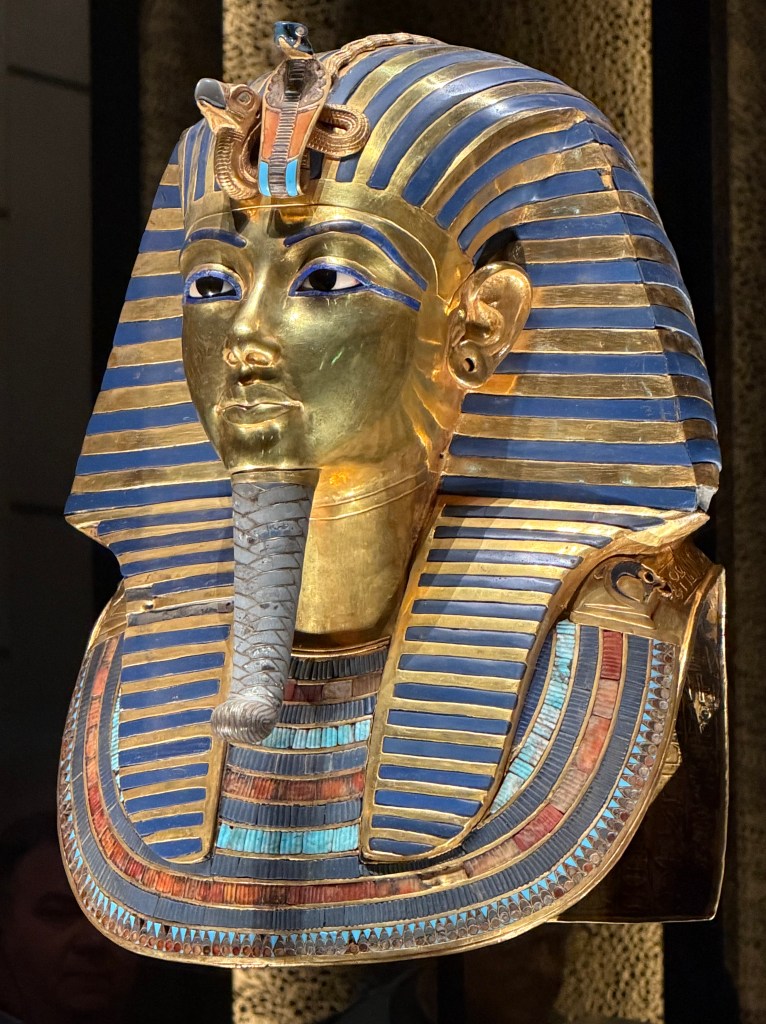
Eventually, we made our way to what was easily my favorite part: King Tutankhamun’s collection. The museum houses approximately 5,000 objects from his tomb, discovered by Howard Carter in 1922 in the Valley of the Kings. Because his tomb was found largely intact — unlike many others that had been looted — it offered an unprecedented glimpse into royal life and burial practices of the New Kingdom.
The collection spans nearly every aspect of his life and death. We saw his jewelry, ceremonial garments, undergarments, sandals, chariots, pottery, furniture, and intricately carved chairs. The jewelry stood out the most to me — the detail, the inlays, the sheer amount of gold and precious stones used. Every piece felt priceless, not just in material but in artistry.
In one grand room stood four massive gilded shrines, layered one inside the other, which once encased his sarcophagus. They were completely covered in gold, towering and luminous. It’s almost impossible to imagine the time and labor required to create something so elaborate. Then we walked around the nested coffins — three layers in total — each increasingly detailed and precious, culminating in the solid gold inner coffin.
And finally, the moment everyone waits for: the famous funerary mask. There was a short line to enter the viewing room, and you could feel the anticipation. Seeing it up close was surreal — far more stunning than any photo. The gold gleamed softly under the lights, the lapis lazuli and colored stones vibrant and precise. It’s incredible how magnetic King Tut remains. While the rest of the museum is vast and extraordinary, this collection clearly draws the largest crowds. I think it’s because of the mystery surrounding his tomb — hidden for centuries and discovered almost perfectly preserved — that makes him so captivating.
After leaving Tut’s gallery, we visited the Khufu Boat Museum, which houses the reconstructed solar boat discovered buried near the Great Pyramid in 1954. The massive wooden vessel, over 4,500 years old, was believed to have been built to carry Pharaoh Khufu in the afterlife alongside the sun god Ra. Seeing a boat of that scale — meticulously reconstructed from thousands of original cedar wood pieces — was another reminder of the sophistication of ancient Egyptian engineering.
Of course, no museum visit is complete without a little shopping. The GEM’s gift shops are beautifully curated — more upscale and definitely more expensive — but it was still fun to browse and pick up a magnet to remember the day. There were also numerous food options, including a delicious gelato stand and even a Ladurée from Paris, which felt wildly unexpected but somehow fitting in such an international space.
You could easily spend an entire day — or more — exploring the GEM. I’m so glad we were among the first wave of visitors to experience it newly opened. It felt incredibly special to witness Egypt presenting its history in such a grand and modern way. It was absolutely worth the visit.
Khan el-Khalili Bazaar
After the grandeur of the GEM, we headed straight into the sensory overload of Khan el-Khalili Bazaar. The transition from sleek, modern museum to centuries-old market streets was dramatic in the best way.
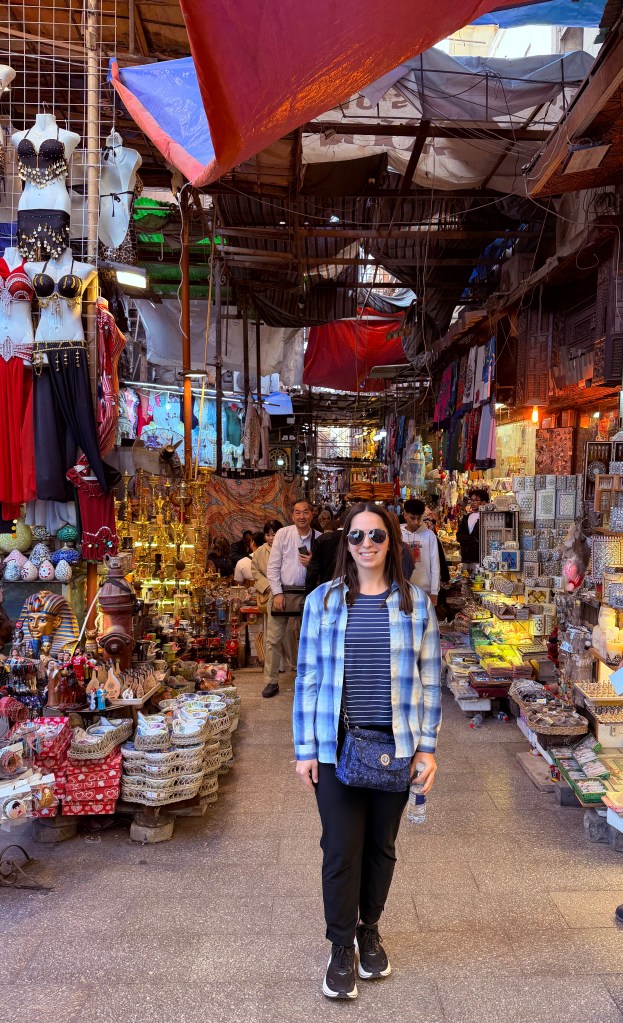
We wound our way through narrow alleyways lined with shop after shop, piles of merchandise spilling out onto the sidewalks. Lanterns, scarves, spices, perfumes, trinkets — it felt endless. The bazaar stretches as far as the eye can see, a maze of color and movement. While it’s certainly catered heavily toward tourists — with plenty of Egypt-themed souvenirs that aren’t necessarily locally made — it still carries an undeniable energy.
Before diving too deep into shopping, we stopped for a late lunch at Naguib Mahfouz Café, named after the famed Egyptian novelist who won the Nobel Prize in Literature in 1988. Located just off the main street of the bazaar, the café had such a distinct atmosphere. The lantern-lit interiors, carved wood details, and traditional music playing softly in the background made it feel cinematic — like we had stepped into the heart of a Middle Eastern film.
I started with the most delicious hummus — creamy, smooth, and perfectly seasoned — followed by koshary, Egypt’s beloved street food. Koshary is a hearty mix of rice, lentils, chickpeas, and pasta, topped with crispy fried onions and tomato sauce. It might sound like an unusual combination, but it works. I added spicy red sauce, garlic sauce, and extra tomato sauce, mixing it all together — and it was so good I finished every bite.
After lunch, we ventured back into the maze of shops. Our guide took us away from the main tourist-heavy stretch to a wholesale store called Galal. Tucked away from the aggressive bargaining and vendors calling out to passersby, this shop had clearly marked, low prices — no negotiating required. It was such a relief to browse without pressure. The space was packed with souvenirs — scarves, papyrus art, small statues, and gifts — and I picked up a few things for myself and family.
On the drive back to the hotel, we passed an enormous local flea market. The sheer number of people was unbelievable — crowds weaving between stalls, vendors selling everything imaginable. Cairo is home to over 20 million people, and in that moment, it felt like they were all there. With Ramadan starting in about a week, many families were out preparing and shopping, which made it even busier than usual.
The contrast between the polished grandeur of the GEM and the chaotic charm of Khan el-Khalili perfectly captured Cairo — ancient and modern, structured and spontaneous, monumental and deeply human — all at once.
Pyramids of Giza
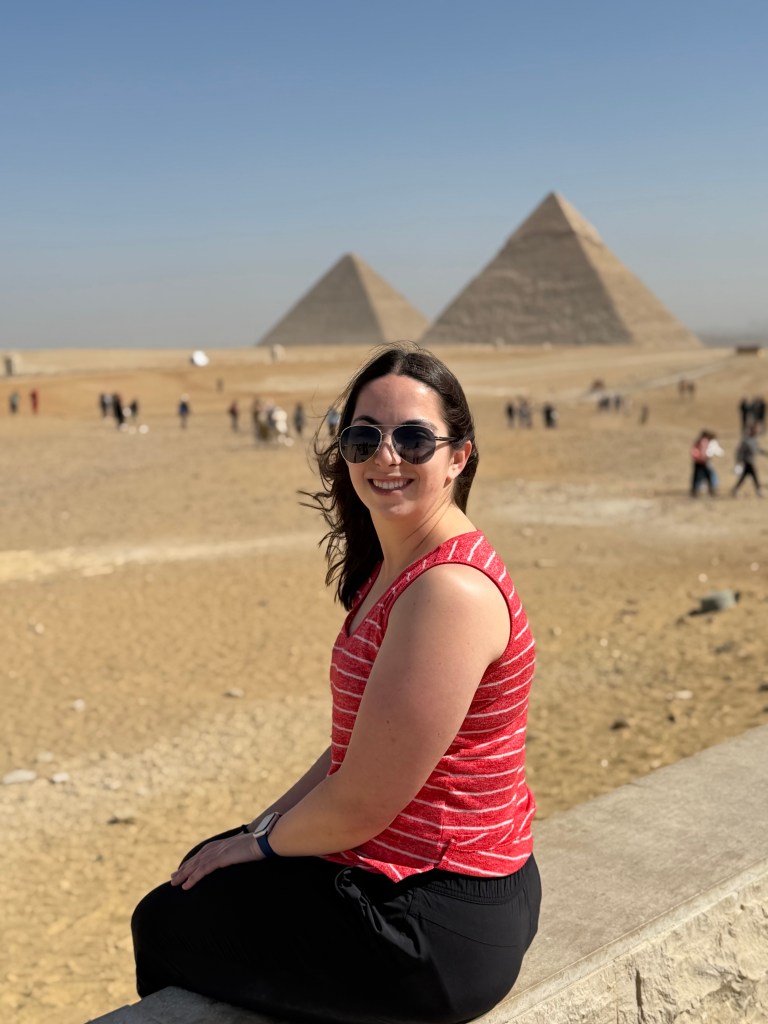
On our very last full day, we finally made it to what we’d been waiting for all trip long: the Pyramids of Giza. Even pulling up to the plateau felt surreal. There’s something about seeing them rise out of the desert haze that makes your brain do a double take — like, are they actually that big?
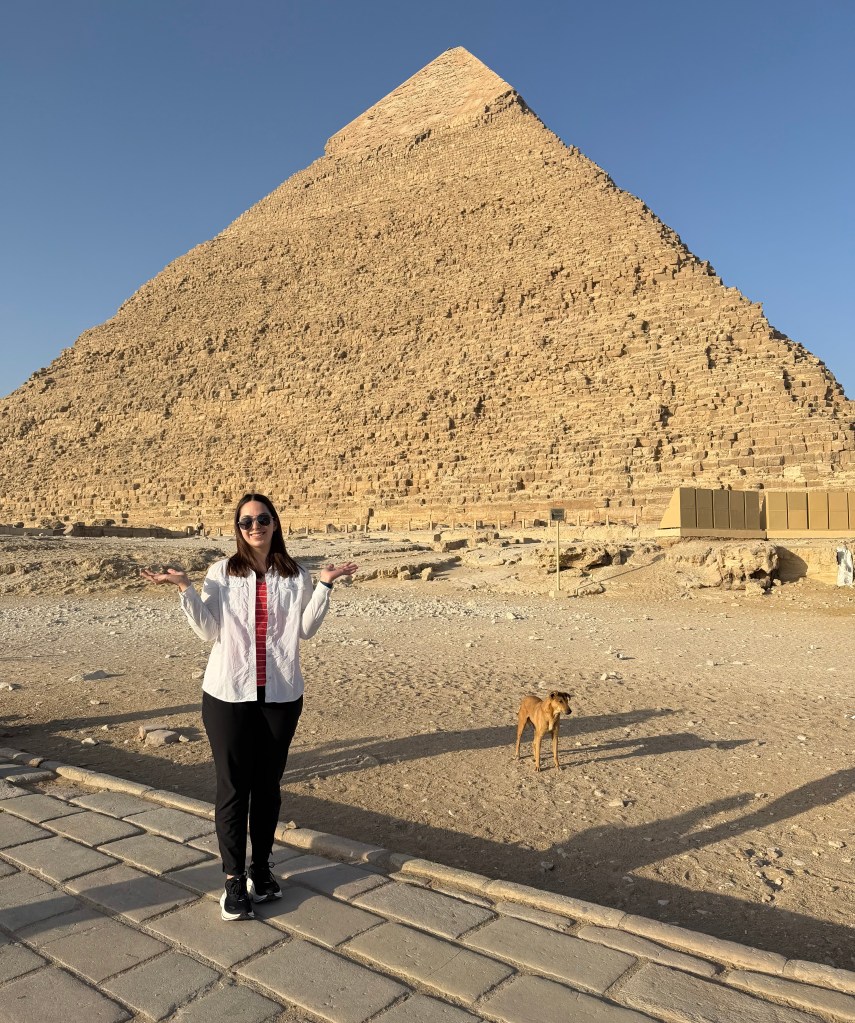
A bus took us around to different vantage points — panoramic overlooks and closer stops — but our guide had a trick up her sleeve. While most tour groups hop off at the first panoramic viewpoint, she had us go straight down to the base of the Great Pyramid of Giza. There was almost no one there. Standing at the base, looking straight up at those massive limestone blocks stacked toward the sky, was overwhelming in the best way. You don’t just see the pyramid — you feel the scale of it. It’s the last remaining Ancient Wonder of the World, built around 2560 BCE for Pharaoh Khufu, and somehow it’s still standing. Touching the stones and walking up a few of the lower steps (you can go inside, but it’s very cramped and there’s not much to see) felt like physically connecting with history.
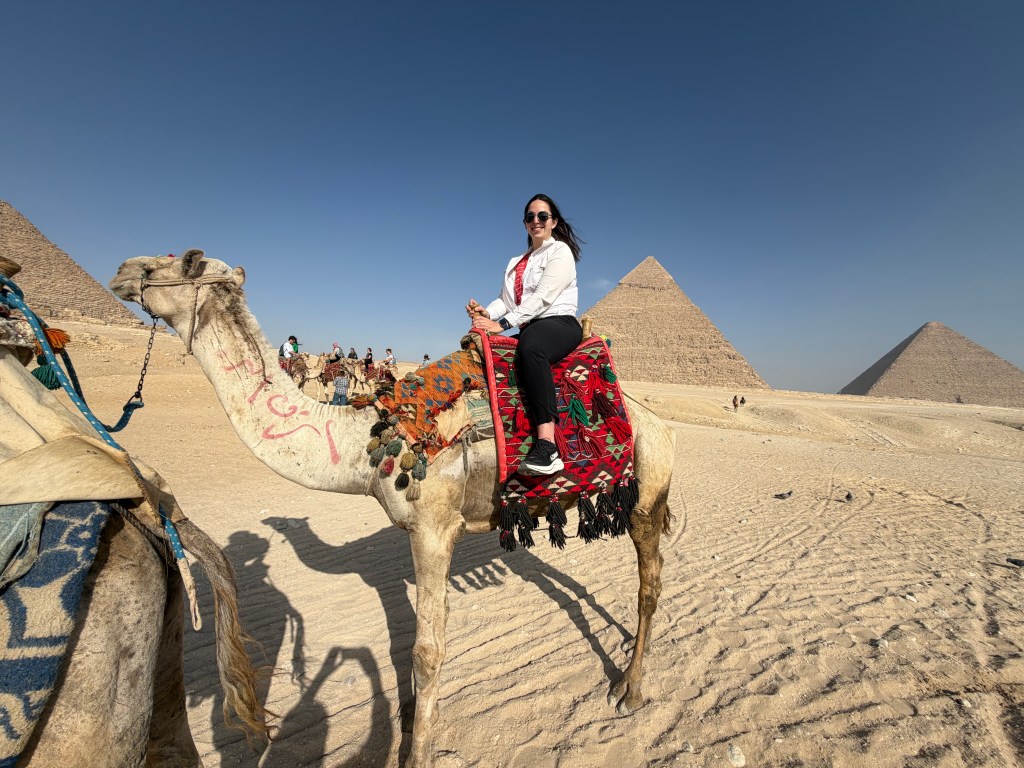
Of course, I had to do the classic camel ride. Sitting up high with the pyramids in the background, desert wind in my hair, I genuinely felt like I was in a movie. The vantage point from the camel made for some of the most incredible photos of the entire trip. What surprised me most, though, was how built up the area is — shops, vendors, stalls everywhere. You could easily spend hours wandering through it all.
We ended at the Sphinx, which was definitely more crowded but still so impressive. Seeing it with the pyramids behind it, knowing it’s stood guard over the plateau for more than 4,500 years, was just unreal. Our final stop was the panoramic viewpoint where you can see all three pyramids lined up together. It was wildly windy and packed with people, but getting that full perspective — realizing just how massive they are — was completely mind-blowing.
Papyrus Institute
After the pyramids, we stopped at a papyrus institute to learn how traditional papyrus paper is made. They showed us how the papyrus plant is sliced into thin strips, soaked, layered in a crisscross pattern, pressed, and dried into sheets — a technique the ancient Egyptians perfected thousands of years ago.
Then came the gallery, filled wall-to-wall with vibrant scenes painted on papyrus. I ended up buying one depicting the goddess of justice with her wings spread, alongside Queen Nefertari and the god Ra. It felt distinctly Egyptian — colorful, symbolic, and rooted in history — and like the kind of souvenir I’ll actually treasure for years.
Last Lunch in Egypt, Saqqara, and Memphis
We stopped for lunch at a tourist restaurant called Pharaoh’s, just outside the entrance to Saqqara. They greeted us with singing and dancing, and women were pulling fresh Egyptian bread straight from a clay oven and handing it to us to try. It was warm, soft, and absolutely addictive.
The meal was a full spread of appetizers — baba ganoush, cabbage rolls, falafel, eggplant, tahini — followed by lamb kofta and chicken brought out on large charcoal grills. Everything was smoky, flavorful, and exactly what we needed after a hot morning in the desert. And because no meal is complete without dessert, they served fresh date ice cream, rolled into delicate little sheets. It was so refreshing and honestly one of the most unique desserts I’ve had.
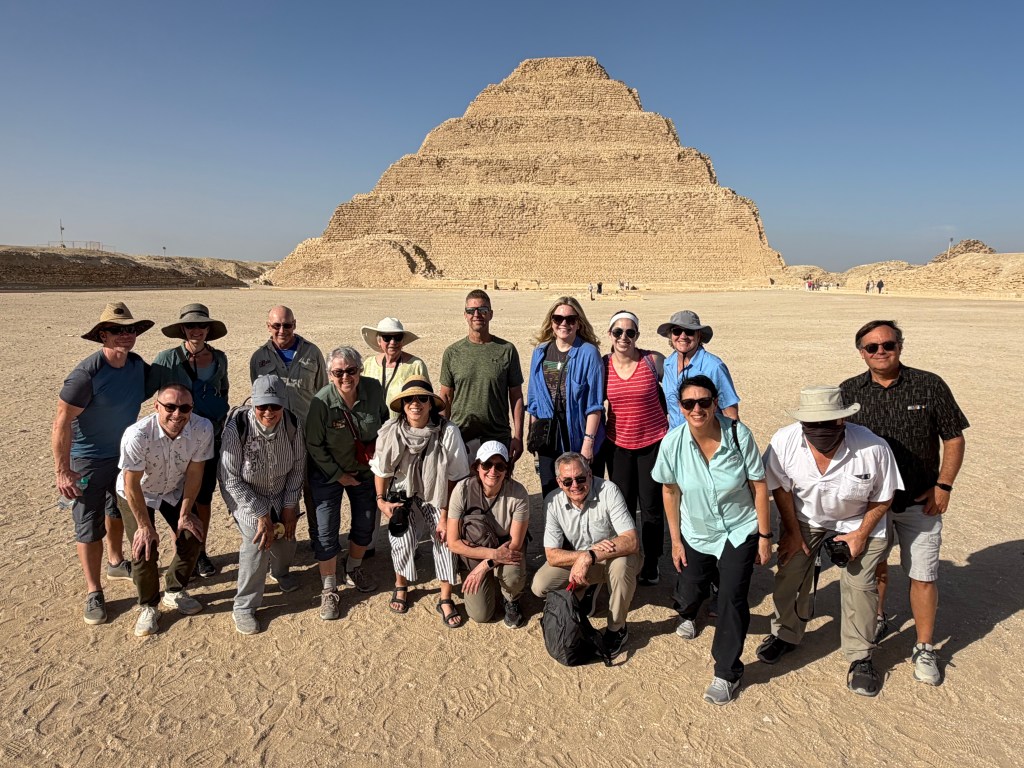
Then we headed into Saqqara, one of Egypt’s most important archaeological sites. Saqqara served as the necropolis for the ancient capital of Memphis and dates back over 4,500 years. It’s home to the Step Pyramid of Djoser, built around 2670 BCE — the world’s first pyramid and the earliest large-scale stone structure in history.
We first visited the funerary complex of King Teti, a Sixth Dynasty pharaoh. To reach the burial chamber, we had to crawl down a narrow passageway, which made the reveal inside even more dramatic. The walls were covered in Pyramid Texts — some of the oldest religious inscriptions in the world — carved into the stone. Knowing this was older than the pyramids of Giza made it even more impressive.
Next was the Tomb of Kagemni, a high-ranking official from the same period. This one was incredible for its detailed reliefs — scenes of daily life, animals, offerings — and so many of the colors were still preserved. I loved how intimate it felt compared to Giza, and our guide’s explanations brought all the scenes to life.
And then, of course, the Step Pyramid itself. It was enormous and striking — and surprisingly uncrowded. It almost felt like we had it to ourselves. I couldn’t believe this was the world’s first pyramid, predating Giza, yet it doesn’t get nearly the same recognition. (The Giza pyramids are famously aligned with Orion’s Belt and are more widely known.) We also saw what are considered the world’s first stone columns and a massive stone enclosure wall. It truly felt like walking through the earliest chapter of monumental architecture.
From there, we drove to Memphis, the ancient capital of Egypt, founded around 3100 BCE by King Menes. For centuries, it was the political and cultural heart of the country. Today, it’s an open-air museum, the result of extensive excavations uncovering statues and ruins from the once-great city.
The highlight was the colossal statue of Ramses II lying on its back in a covered gallery. The detail was incredible — from the carved facial features to the hieroglyphs along the body. Outside, the open-air museum displayed more treasures from the site, including a large alabaster sphinx. It was the perfect way to close out such a history-packed day.
Last Bite in Egypt
My final meal in Egypt was at Café Beirut, right across the street from our hotel in Cairo. I had a few hours before heading to the airport and wanted something hearty to send me off.
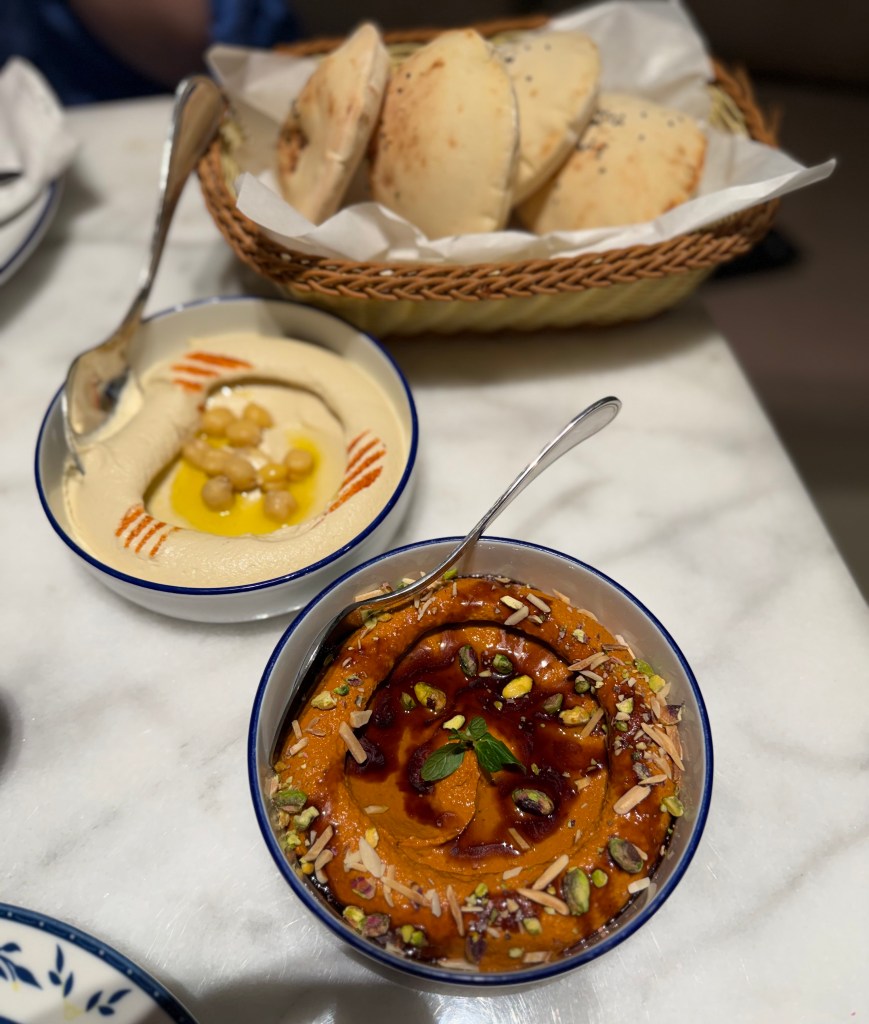
I started with hummus and muhammara — the red pepper and walnut dip — and it was some of the best I’d had all trip. Smooth, smoky, slightly sweet, and beautifully presented. Then I ordered a beef shawarma sandwich with fries, which completely hit the spot.
It felt like the perfect last bite — simple, flavorful, and deeply satisfying. As I sat there, I couldn’t help but reflect on how much I’d experienced in just a short time: the history, the architecture, the people, the food, the culture. Egypt was everything I hoped it would be and more.
Alexandria, Egypt
Alexandria is beautifully situated along the Mediterranean, and we had two nights to explore this ancient city shaped by Greek, Egyptian, and Roman influences. From the moment we arrived, it felt distinctly different from Cairo — still lively and noisy in that unmistakably Egyptian way, but softened by a Mediterranean ease and a touch of European flair. There was a laid-back rhythm to the city that made wandering feel effortless.
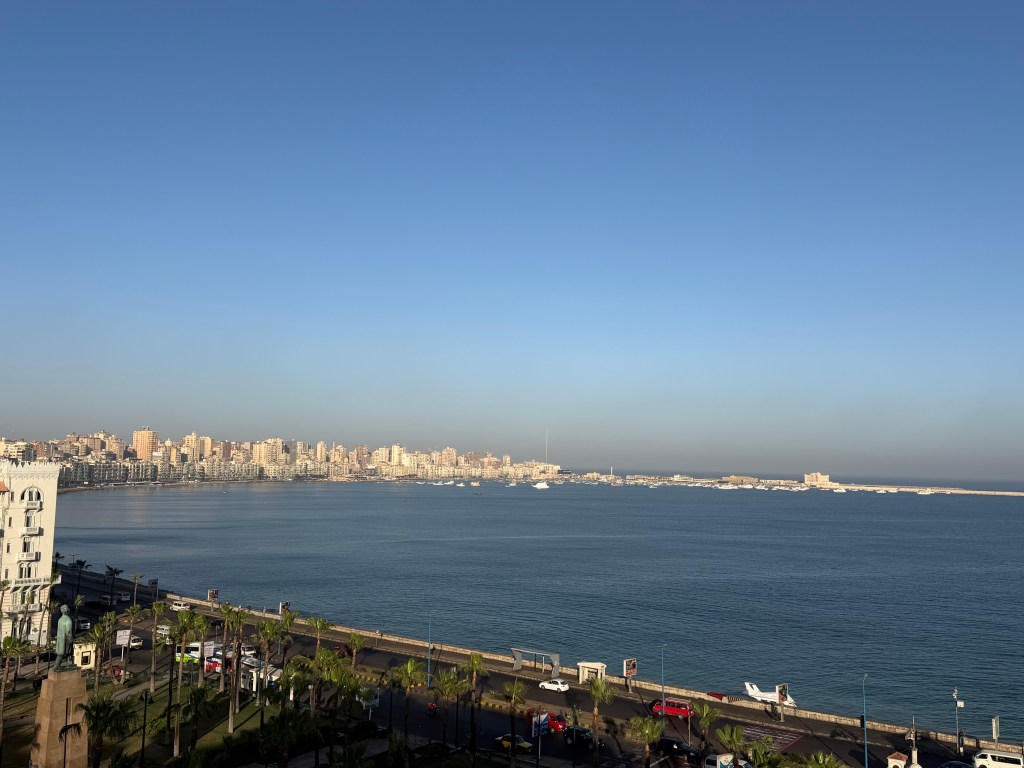
We stayed at the historic Le Metropole Hotel, perfectly positioned along the Corniche with sweeping rooftop views of the ocean and the city skyline. Opened in the early 1900s, the hotel has long been a gathering place for writers, diplomats, and travelers passing through Alexandria’s golden age. Its old-world charm and unbeatable location made it an ideal base for exploring the city, whether on foot or simply by watching the Mediterranean drift by below.
St. Bishoy Monastery
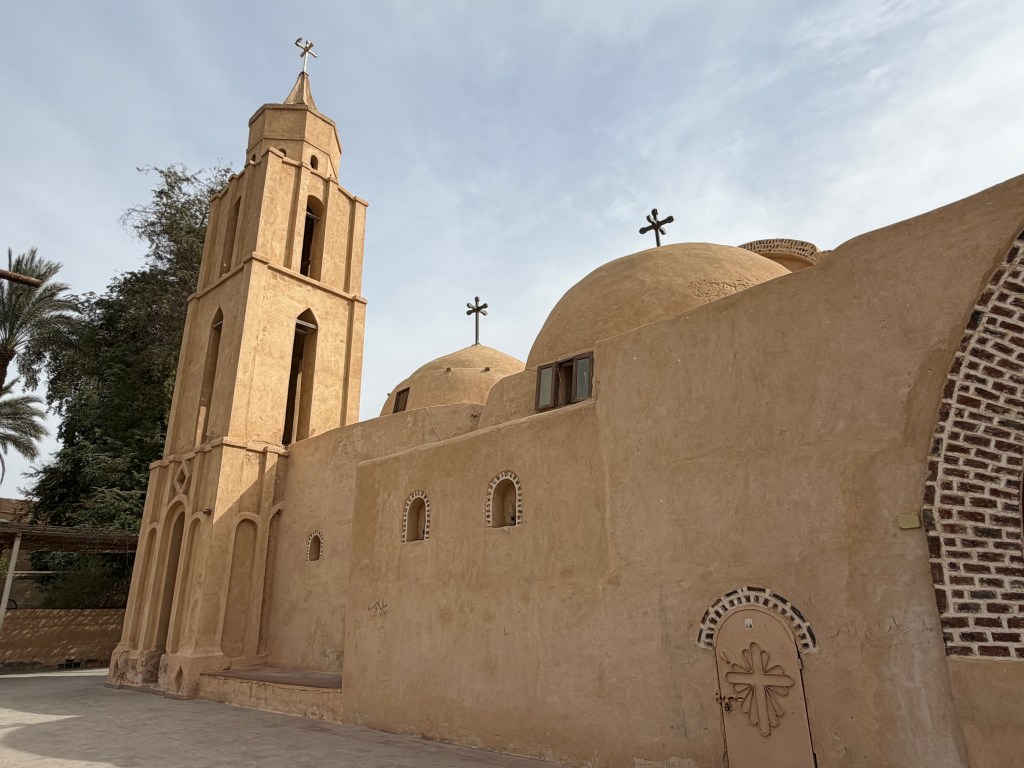
On our drive from Cairo to Alexandria, we made a special stop at St. Bishoy Monastery, a Coptic Christian monastery tucked away in the desert of Wadi El Natrun. Founded in the 4th century and named after Saint Bishoy, one of the most revered Desert Fathers, the monastery has been a spiritual center for centuries and remains active today.
I was immediately drawn to the architecture — elegant Coptic arches paired with sandstone domes that felt deeply Middle Eastern, blending faith and landscape seamlessly. A monk graciously guided us through the complex, showing us the church, the simple living quarters where monks still reside, and a museum dedicated to Pope Shenouda III, the 117th Pope of the Coptic Orthodox Church and one of the most influential religious figures in modern Egypt.
It felt incredibly special to experience the monastery this way, quietly and intimately, knowing that many travelers never get the chance to visit. There was a sense of calm and authenticity that stayed with me long after we left.
Catacombs of Kom el Shoqafa
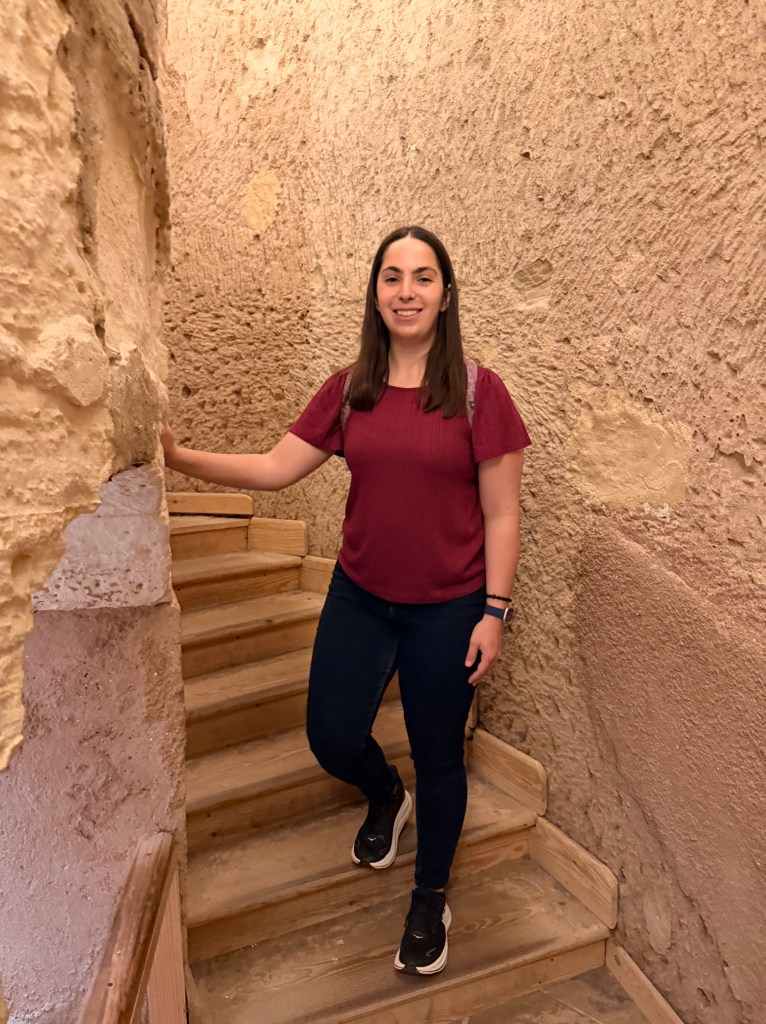
Visiting the Catacombs of Kom el Shoqafa felt like stepping into another world — an underground adventure layered with mystery and history. Dating back to the Roman period, these catacombs are a fascinating blend of Egyptian, Greek, and Roman burial traditions, carved deep beneath the city.
What struck me most were the endless small chambers, hidden passageways, and niches lining the walls. The space felt eerie and almost haunted, especially knowing it once held generations of the dead. One of the most memorable features was the central “well,” used to lower bodies down into the tombs — a chilling but ingenious solution.
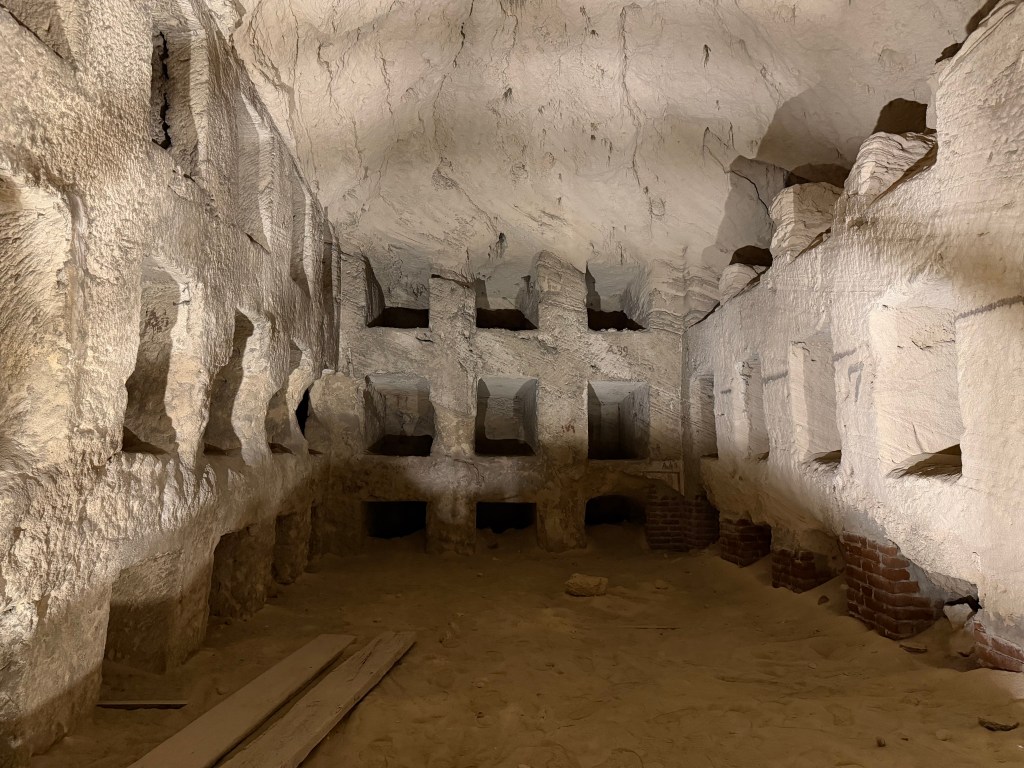
There was also a large hall with flat stone platforms where families once held Roman-style feasts in honor of their loved ones. Standing there, I couldn’t help but imagine the conversations, the tears, and the food shared in remembrance. The catacombs are said to get their name from the overwhelming amount of shattered pottery found on site — visitors would bring food in clay vessels and intentionally break them before leaving, leaving behind layers of fragments that still remain today.
Pompey’s Pillar
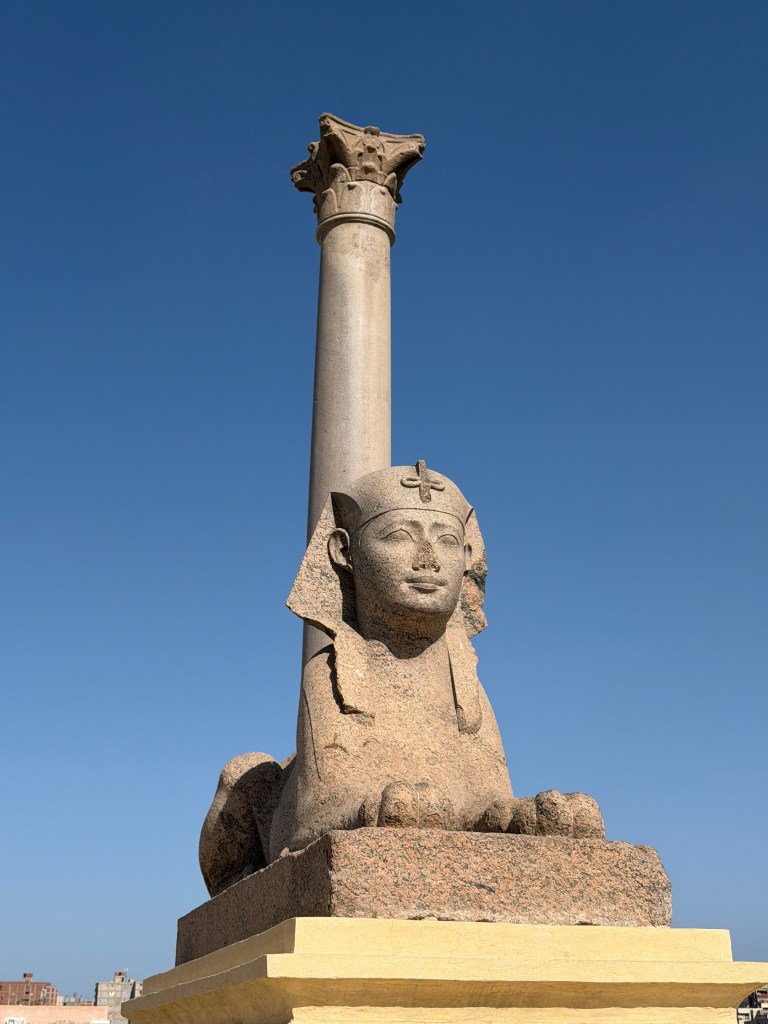
Set right in the heart of modern Alexandria, Pompey’s Pillar was one of the most striking examples of ancient history colliding with contemporary city life. Rising dramatically above the surrounding neighborhood, the massive granite column dominates the site — technically not a “pillar” at all, since it’s a single round column, but the name has endured.
Built in 297 AD in honor of Emperor Diocletian, the column once stood within the grand Serapeum, a sanctuary dedicated to the Greco-Egyptian god Serapis. Two majestic sphinx statues guard the area, adding to the sense of scale and reverence. Beneath the ground lie the remains of underground chambers and library spaces, which felt reminiscent of the catacombs — similar in atmosphere, but created for worship and learning rather than burial. Seeing this ancient sanctuary surrounded by modern buildings made the experience even more surreal.
The Library of Alexandria
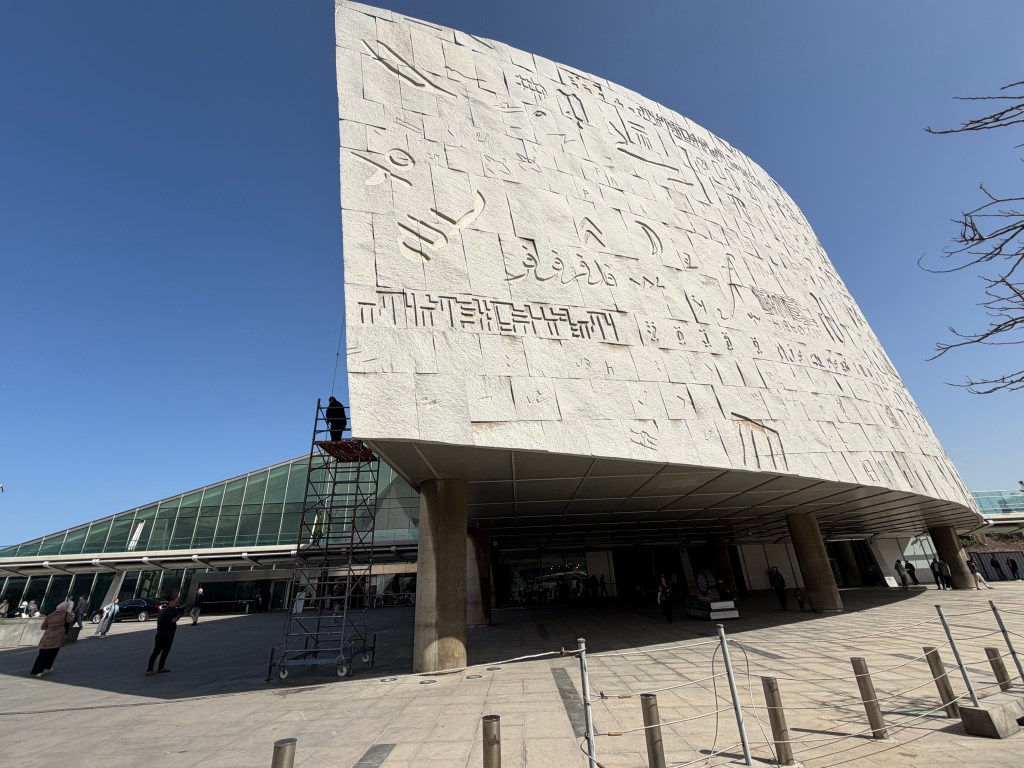
The Bibliotheca Alexandrina was nothing short of breathtaking. From the outside, the modern architectural design is striking and symbolic, rising from the waterfront like a tribute to knowledge itself. Inside, it houses the largest open reading room in the world — an awe-inspiring space flooded with light and quiet purpose.
The original Library of Alexandria, founded in the 3rd century BC, was once the greatest center of learning in the ancient world. The modern library, opened in 2002, honors that legacy while redefining it for the present. During our guided tour, we learned how the library is far more than its physical collection of over two million books. Through digitization and research initiatives, it makes texts accessible in multiple languages to readers around the world.
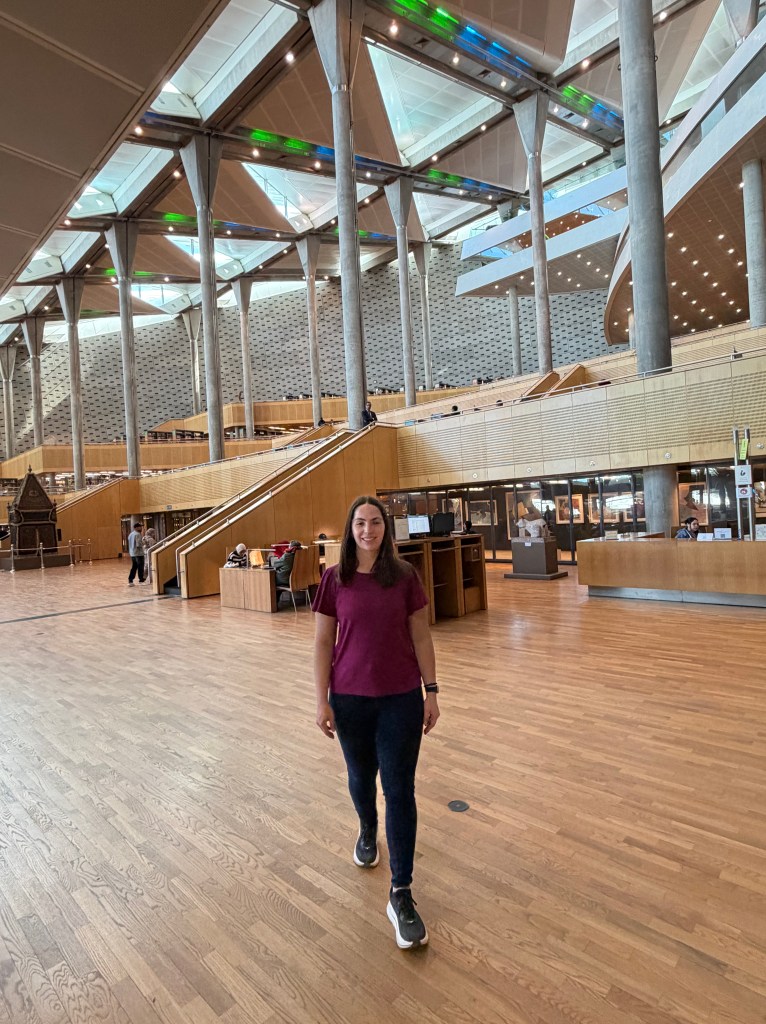
The complex also includes several museums and artifact collections. My favorite was a photography exhibit showing Alexandria through the eyes of travelers over time — it was fascinating to see how the city has evolved while still holding onto its soul. With a conference center for lectures and concerts, a planetarium, and endless spaces to explore, you could easily spend an entire day (or more) wandering the library alone.
Seafood & Mediterranean Views
Of course, being on the Mediterranean meant one thing — fresh seafood. We stopped for lunch at Branzino, a spot right on the water where you choose your fish straight from the display. They weigh it, grill it to perfection, and serve it simply, letting the freshness speak for itself. I was especially proud to order the local red snapper — and even more proud that I deboned it myself.
Later that afternoon, we walked along the Corniche back toward our hotel, taking in the skyline and the endless blue of the sea. Below us, fishermen worked along the water’s edge, and the city buzzed all around. It felt hectic and unmistakably Egyptian, yet softened by that Mediterranean rhythm I’ve felt in other coastal countries — a perfect reflection of Alexandria itself.
One Last Bite of Alexandria
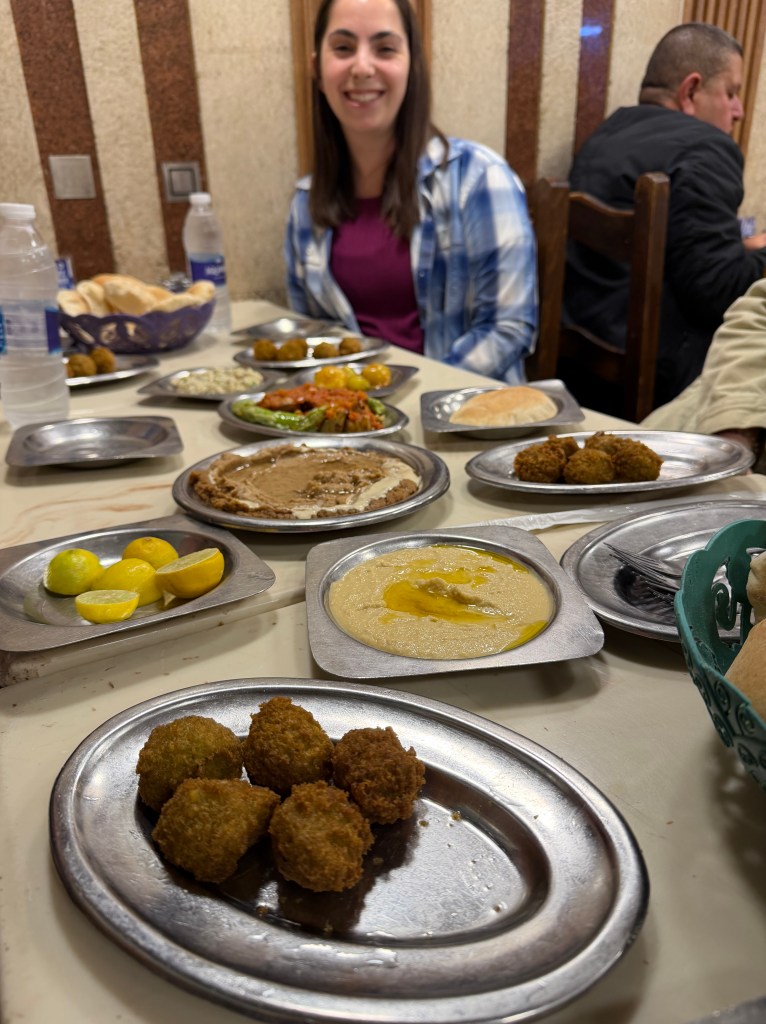
Our last dinner in Alexandria ended up being one of the most memorable meals of the whole trip. A group of us wandered across the street from the hotel to Mohamed Ahmed Restaurant, a tiny hole-in-the-wall spot I’d flagged in my guidebook and that our guide seconded. We ordered everything and spread it across the table—falafel, pita, moussaka, baba ganoush, hummus, ful, pickled lemon, and fries—and happily shared it all. Every bite was incredible, and somehow the entire feast cost about $2 per person, tip included. It was a perfect reminder that some of the best travel moments (and meals) happen when you step a little outside your comfort zone, skip the hotel dining room, and eat where the locals do.

Leave a comment