Visiting Aswan and Luxor — and traveling between them by way of the Nile — felt like the most authentic way to experience Egypt. Cruising along the river that has sustained this civilization for thousands of years offered a perspective you simply can’t get from the road. From the calm, slower rhythm of Aswan to the vibrant energy and overwhelming history of Luxor, each stop revealed a different side of the country. Watching daily life unfold along the riverbanks, with palm trees, desert landscapes, and ancient temples appearing in the distance, made the journey itself just as meaningful as the destinations.
Aswan, Egypt
Aswan feels completely different from the major cities of Cairo and Alexandria in Egypt, especially in both size and overall atmosphere. The pace here is noticeably slower, more relaxed, and deeply connected to the rhythm of the Nile River. Life seems to unfold along the water, and everything feels more centered around it.
There’s a calmness to Aswan that makes you want to slow down and be present. Between the river views, traditional boats drifting by, and the quieter streets, it feels like stepping back in time—into a version of Egypt where history isn’t just something you visit, but something you live alongside.
Philae Temple: A Testament to Devotion and Survival
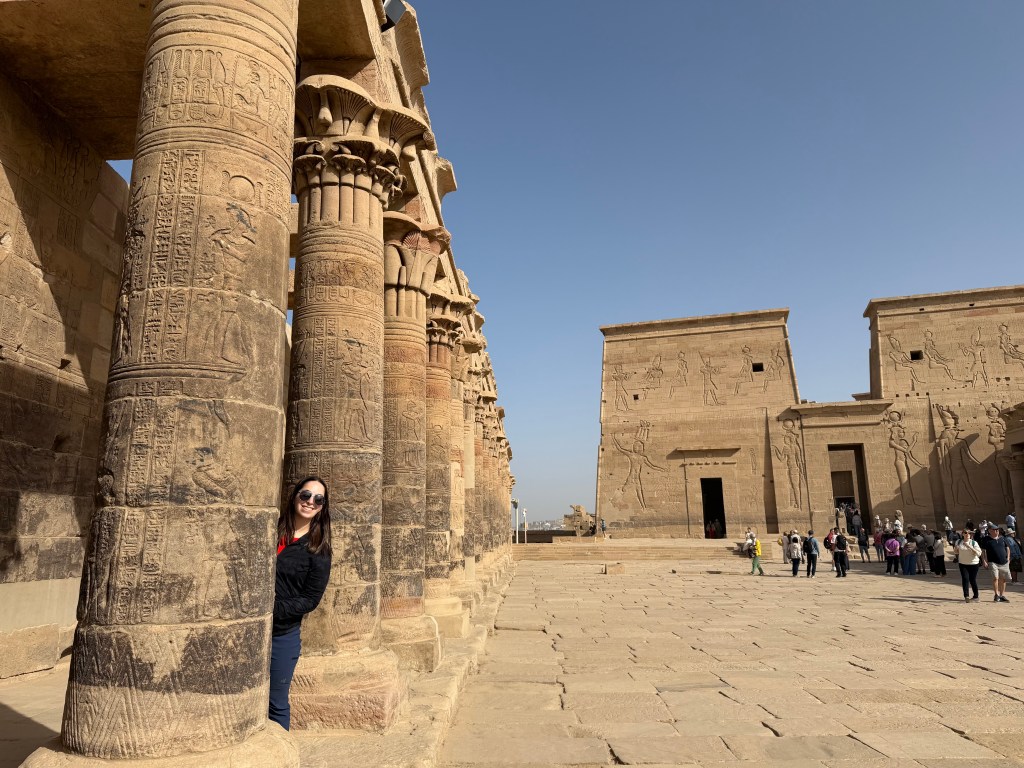
One of the most memorable experiences in Aswan was visiting Philae Temple, a stunning complex dedicated primarily to Isis, the goddess of magic, motherhood, and healing. Set on an island in the Nile, the temple feels almost ethereal as you approach it by boat, surrounded by water that reflects both the sky and the stone.
Philae has a long and layered history. Originally built during the Ptolemaic period and expanded under Roman rule, it was one of the last active centers of ancient Egyptian religion. Even as Egypt transitioned through different empires and belief systems, worship at Philae continued for centuries.
Walking through the temple, I was especially drawn to the intricate carvings and hieroglyphics covering the walls. These images tell stories of Isis, Osiris (god of the afterlife and resurrection), and Horus (the falcon-headed god of kingship and protection). Scenes of offerings, rituals, and divine symbolism are carved with remarkable detail, making the temple feel like a stone storybook.
What fascinated me most was learning about the layers of history etched into the walls. As different groups passed through Egypt, they left their marks behind. Egyptians, Greeks, and Romans all occupied or visited the site, and their presence is still visible today. Some ancient carvings were defaced, others written over, and in some areas the Romans even sharpened their swords against the stone, permanently damaging the hieroglyphics. While it’s heartbreaking to see parts of the artwork destroyed, it also serves as a powerful reminder that this temple lived through centuries of change.
Philae isn’t just beautiful — it’s resilient. Its survival, relocation, and preservation make it one of the most meaningful sites I’ve visited so far in Egypt.
Aswan’s Essential Oils & Glass-Blowing Traditions
While in Aswan, we also visited an essential oil and fragrance shop, where we learned how traditional Egyptian oils are made. From floral scents like lotus and jasmine to deeper, earthier fragrances, it was fascinating to see how these oils are extracted and blended using techniques passed down through generations.
We were able to sample several scents, learning how different oils are used for everything from perfume to wellness and spiritual practices. The experience felt immersive and sensory in the best way — a break from temples and history, but still deeply connected to Egyptian culture.
The shop also featured glass-blowing demonstrations, where artisans showed how molten glass is shaped by hand into delicate bottles. These beautifully crafted glass pieces are often used to hold the oils, turning each fragrance into both a scent and a keepsake. Watching the process made me appreciate the craftsmanship even more, knowing how much skill and precision goes into each piece.
Feluca Sailing & a Nubian Dinner on the Nile
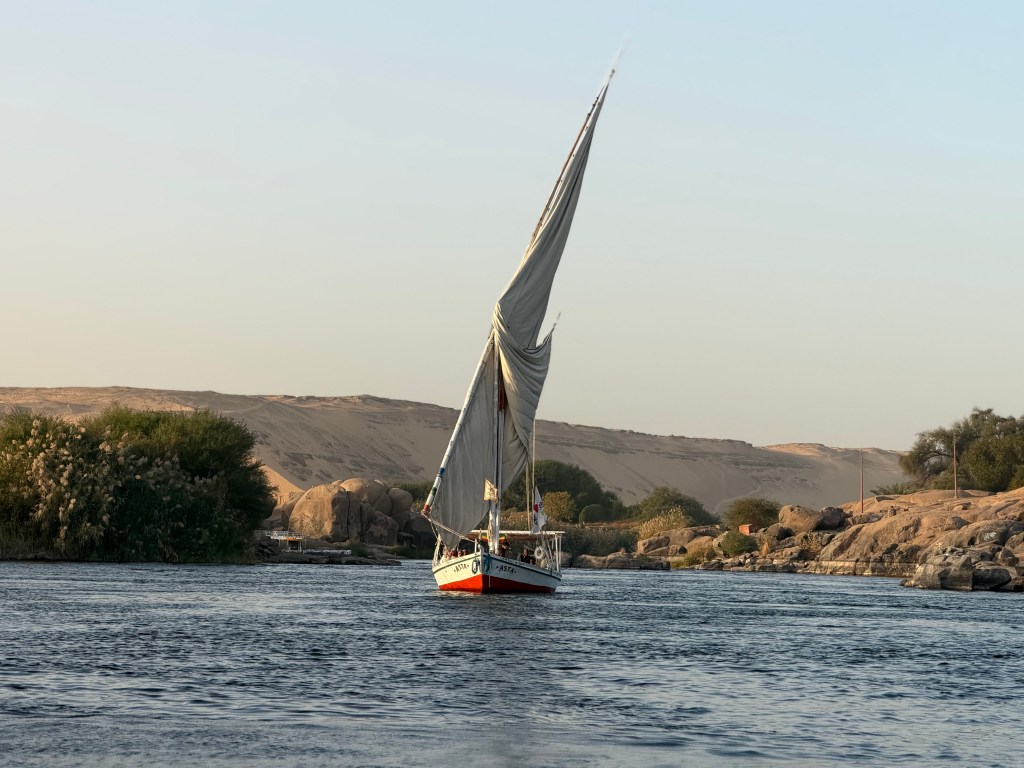
One of the most peaceful experiences in Aswan was riding a feluca boat along the Nile, drifting quietly with the wind as the desert stretched out on both sides. The entire ride felt cinematic — like being dropped into an ancient Egypt movie — calm, slow, and timeless, with nothing but water, sand, and sky surrounding us.
After the sail, we were welcomed into a local Nubian family’s home (the Indigenous people of southern Egypt), giving us a glimpse into everyday village life. Children were playing soccer in the streets, neighbors gathered and chatted, and from the rooftop of our host’s home we watched the sunset over the Nile, a view that felt incredibly special and intimate.
The evening ended with a home-cooked feast — lentil soup, pita, chicken, moussaka, Egyptian rice, potatoes, and a delicious filo pastry filled with cheese — all shared with warmth and generosity. It was such a meaningful way to connect with local people and give back, especially knowing that even small purchases, like the camel wood carving I bought from locals on the feluca, directly support the community. A truly unforgettable and heart-felt experience.
Abu Simbel: A Temple Worth the Journey
One of the most unforgettable experiences of the trip was visiting Abu Simbel, a site that feels both remote and monumental in every sense. From Aswan, it’s about a three-hour drive each way by bus, and because it’s not included on most itineraries, it felt extra special knowing we were going somewhere truly out of the way. We had a very early 4:30 a.m. wake-up call so we could arrive first thing in the morning, just as the desert light was beginning to change.
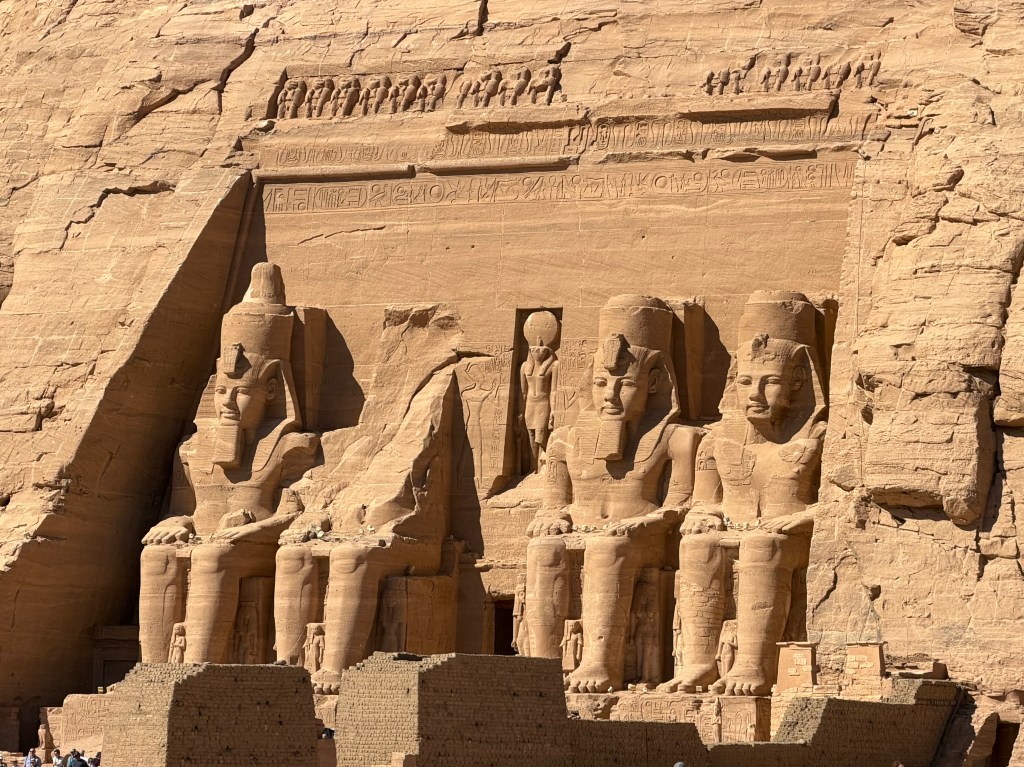
Abu Simbel is made up of two temples built during the reign of Ramses II, originally carved directly into a mountainside. When the Aswan High Dam was constructed in the 1960s, the temples were threatened by flooding from what is now Lake Nasser. In one of the most ambitious archaeological rescue efforts ever attempted, the entire complex was carefully cut into massive blocks, moved, and reconstructed on higher ground. Standing there today, you can actually see the line where the original mountain ends and the reconstructed rock begins — a subtle but powerful reminder of how much effort went into saving this place.
As you turn the corner and face the lake, the iconic façade comes into view: four colossal statues of Ramses II seated side by side, staring out over Lake Nasser. They were absolutely magnificent and unlike anything I’ve ever seen. It’s almost impossible to comprehend that something so massive, detailed, and symmetrical was built thousands of years ago, with such precision and artistry.
Inside the main temple, the scale somehow becomes even more impressive. The walls are covered in incredibly well-preserved carvings and hieroglyphics, telling stories of gods, battles, and royal power. Every surface felt intentional and alive with history. After exploring the main temple, we visited the second temple next door — smaller, quieter, and dedicated to Queen Nefertari. It was equally beautiful and far less crowded, which made it feel even more special.
Abu Simbel was truly awe-inspiring and absolutely worth the early morning and long drive. It’s the kind of place that stays with you long after you leave.
Kom Ombo: The Crocodile Temple
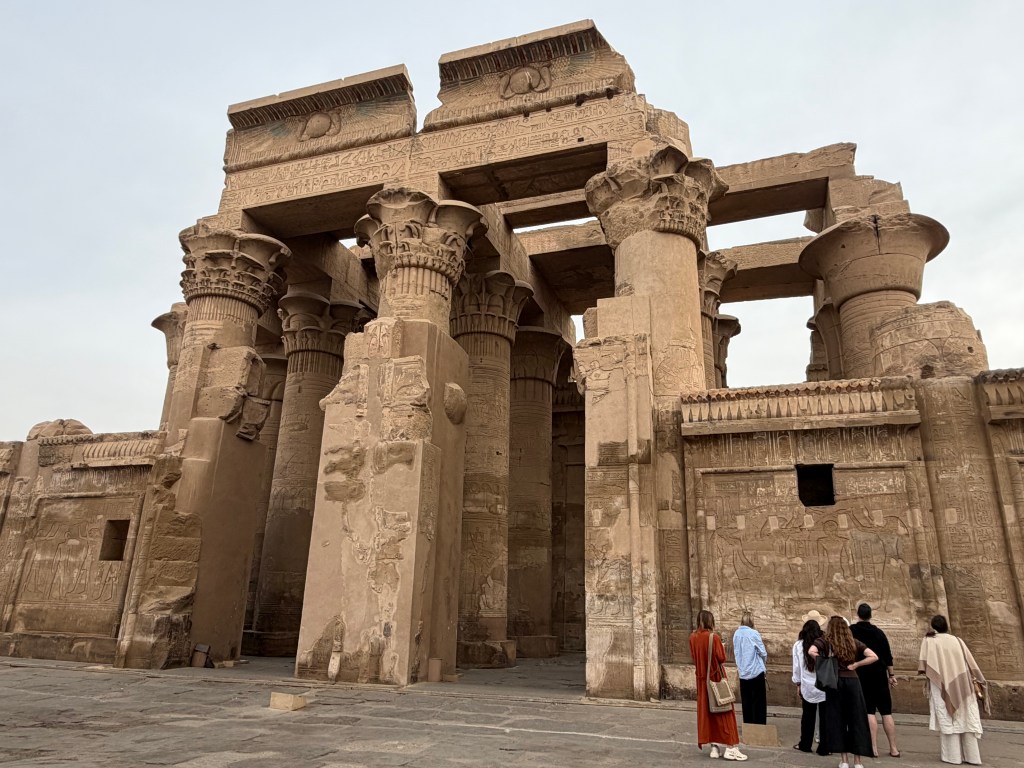
On the first morning of our Nile River cruise, we docked right next to Kom Ombo Temple, making for an incredibly easy and scenic stop. The walk to the entrance was lined with stalls selling souvenirs and trinkets, and I couldn’t resist stopping to negotiate for a few scarves along the way — an experience that’s practically a rite of passage in Egypt.
Kom Ombo is unique because it’s a double temple, symmetrically dedicated to two gods: Sobek, the crocodile god, and Horus the Elder. Compared to some of the other temples we visited, Kom Ombo felt more weathered and partially destroyed, but that somehow made the surviving details even more impressive. The carvings and hieroglyphics on the walls were remarkably well preserved, packed with symbolism and meaning that has shaped so much of what we understand about ancient Egyptian language and belief systems today.
What stood out most was the color. Even after thousands of years, you could still see vibrant reds and deep blues painted into the reliefs. It’s hard to imagine how striking this temple must have been when it was fully covered in bright color — something that completely challenges the way we tend to picture ancient ruins as plain stone.
After visiting the temple, we stopped at the Crocodile Museum, since Kom Ombo is famously associated with Sobek. Ancient Egyptians believed crocodiles were godlike, and many were mummified as offerings. Inside the museum were dozens of massive mummified crocodiles, incredibly well preserved and surprisingly moving to see. It was both fascinating and slightly surreal to stand face-to-face with creatures that were once worshipped thousands of years ago.
Luxor
Luxor feels like a different world the moment you arrive — more upbeat, vibrant, and alive than Aswan, yet just as deeply rooted in history. Often described as the world’s greatest open-air museum, it’s almost unbelievable that nearly one-third of the world’s ancient monuments are located here. Everywhere you turn, layers of history reveal themselves, with ruins that have already reshaped our understanding of the ancient world and so much still waiting to be uncovered. Despite its energy and buzz, Luxor carries a powerful sense of timelessness, where daily life unfolds alongside some of the most extraordinary archaeological sites on Earth.
Karnak & Luxor Temples: Walking Through Ancient Grandeur
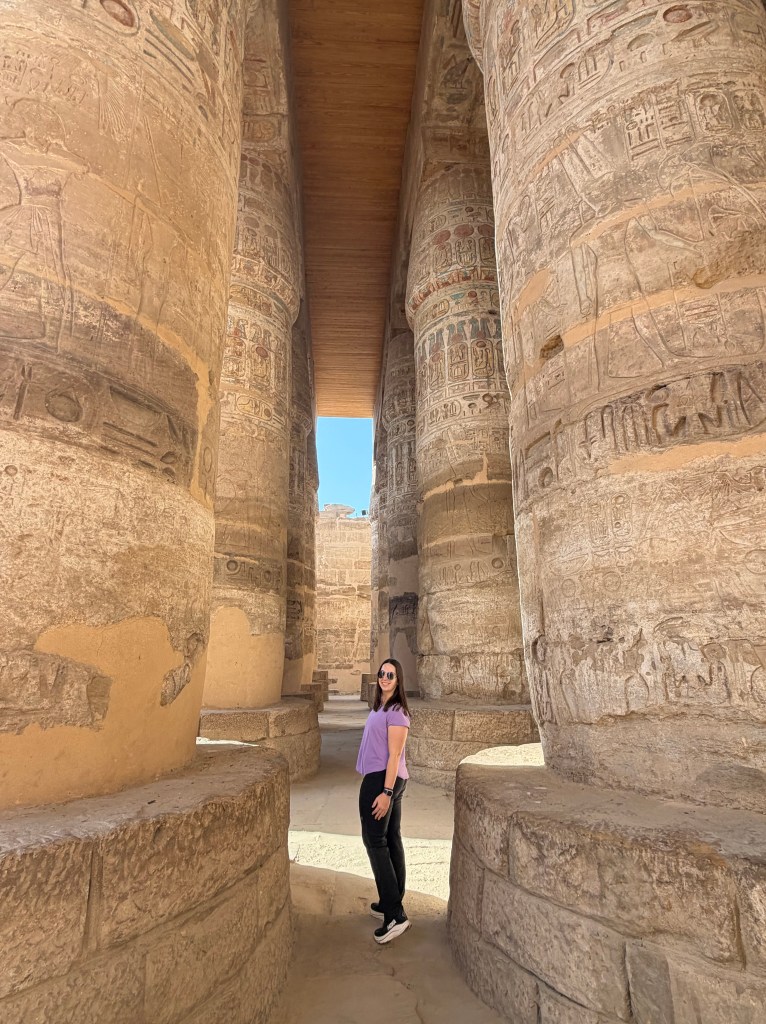
On the second morning of our cruise, we arrived in Luxor — the final stop on our journey along the Nile. It was already shaping up to be the hottest day of the trip, so I was thankful we started early, before the crowds and intense heat set in.
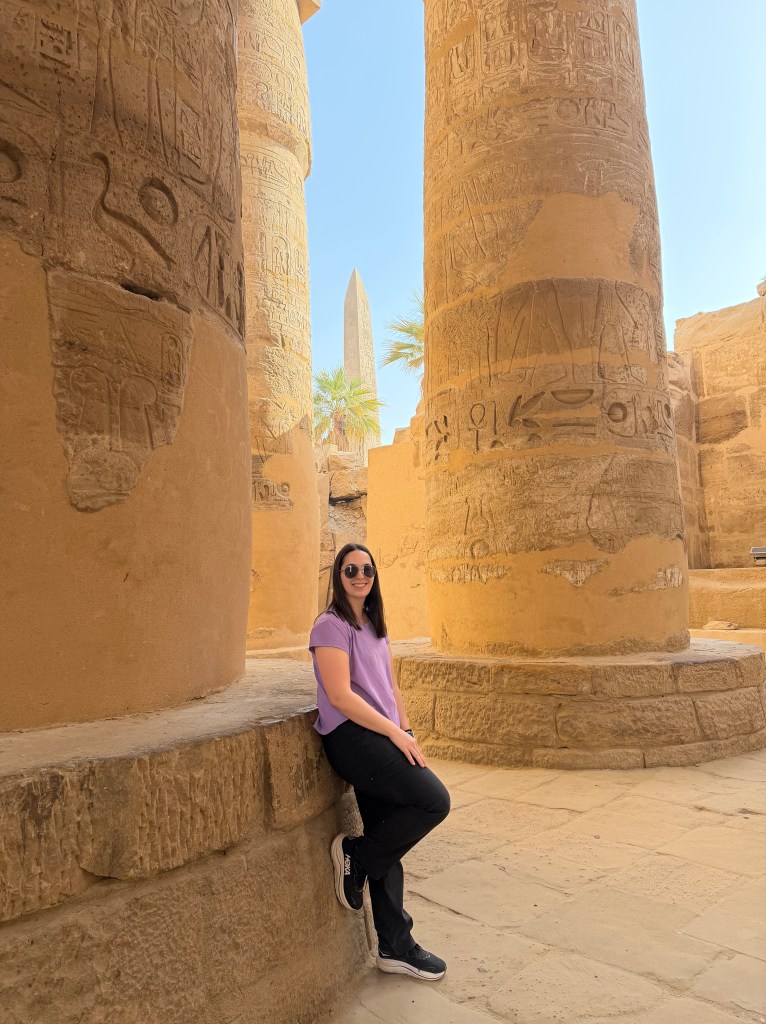
Our first stop was Karnak Temple, one of the largest religious complexes ever built. Constructed over centuries by multiple pharaohs, Karnak feels less like a single temple and more like a sprawling maze of sanctuaries, statues, and courtyards. The moment we entered the main section, I was completely blown away by the Great Hypostyle Hall. Massive columns towered overhead, each one covered in intricate carvings and hieroglyphics. Even more incredible was seeing traces of the original paint — vibrant colors that archaeologists have only recently begun uncovering again.
Scattered throughout the complex were towering obelisks and pyramid-like columns that felt quintessentially Egyptian. In the center of the site was a large sacred lake, once used for ritual purification, adding a sense of calm to the vast space.
Karnak and Luxor Temples are connected by a 2-kilometer avenue lined with sphinxes, and walking along it felt like stepping into an ancient procession route. Luxor Temple itself was equally impressive, guarded by towering statues of Ramses II at the entrance. Built to honor the rejuvenation of kingship, the temple felt more intimate but no less powerful.
Inside, we saw some of the most striking statues of the trip so far, along with a fascinating contrast of history. In the back sections, parts of the original temple walls were painted over by the Romans after they conquered Egypt. Seeing Roman artwork layered directly over ancient Egyptian carvings — separated by thousands of years — was one of the most striking reminders of how many civilizations have passed through this place.
Mortuary Temple of Hatshepsut
On the final morning of the cruise, we woke up early to visit the Mortuary Temple of Hatshepsut. Built for one of Egypt’s most powerful female pharaohs, the temple is dramatically set against towering limestone cliffs in the Luxor region.
As the sun rose, it cast the most beautiful light across the terraces, making the entire structure glow. What made this temple stand out to me was how seamlessly it was integrated into the mountain landscape — almost as if it was carved directly out of the cliffs themselves. The symmetry, scale, and setting were breathtaking.
The temple featured large statues and beautifully preserved carvings depicting Hatshepsut’s reign and divine birth. It felt like the perfect introduction to the Valley of the Kings, with its dramatic backdrop and sense of quiet power.
Valley of the Kings: A World Beneath the Rock
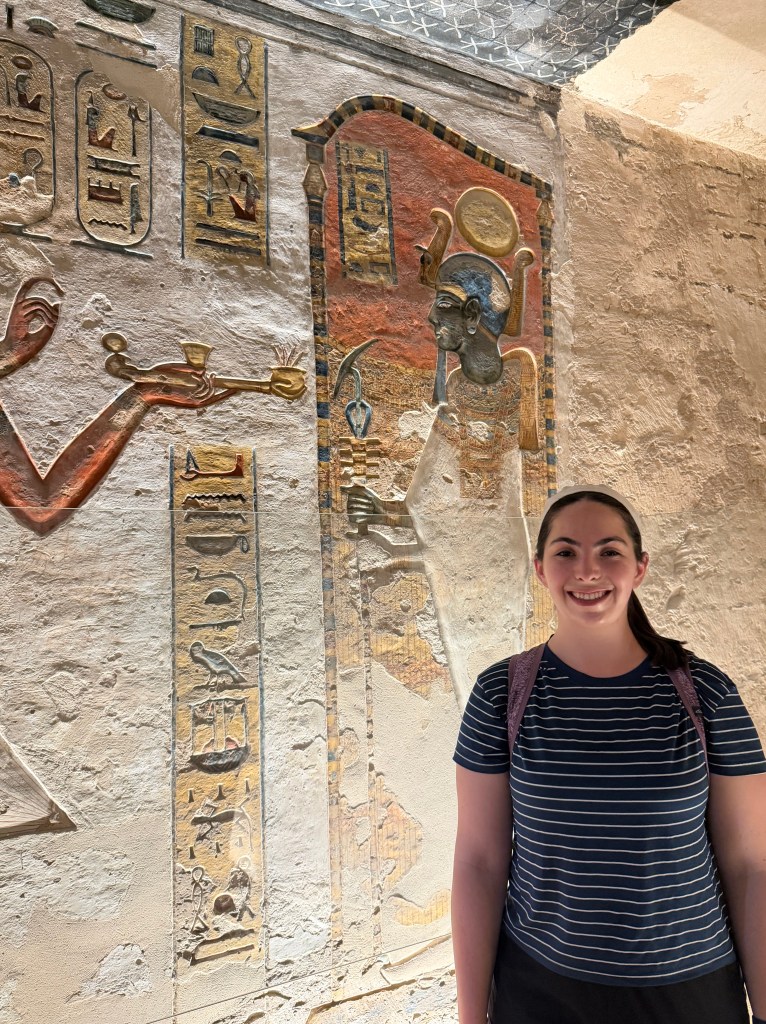
The Valley of the Kings was hands down my favorite experience in the Nile Valley. From the outside, it doesn’t look like much — just barren hills and rocky mounds under the desert sun. But once you step inside the tombs, it’s a completely different world.
This valley served as the burial ground for pharaohs of the New Kingdom, chosen for its isolation and natural protection. Inside the tombs, the walls are covered in astonishingly well-preserved carvings and paintings, many still bursting with their original colors in a way you simply don’t see in outdoor temples.
We arrived at a particularly wild moment — Tiffany Trump happened to be visiting Luxor and the Valley of the Kings the same day. To avoid potential closures, we rushed into a cart and were whisked inside just in time.
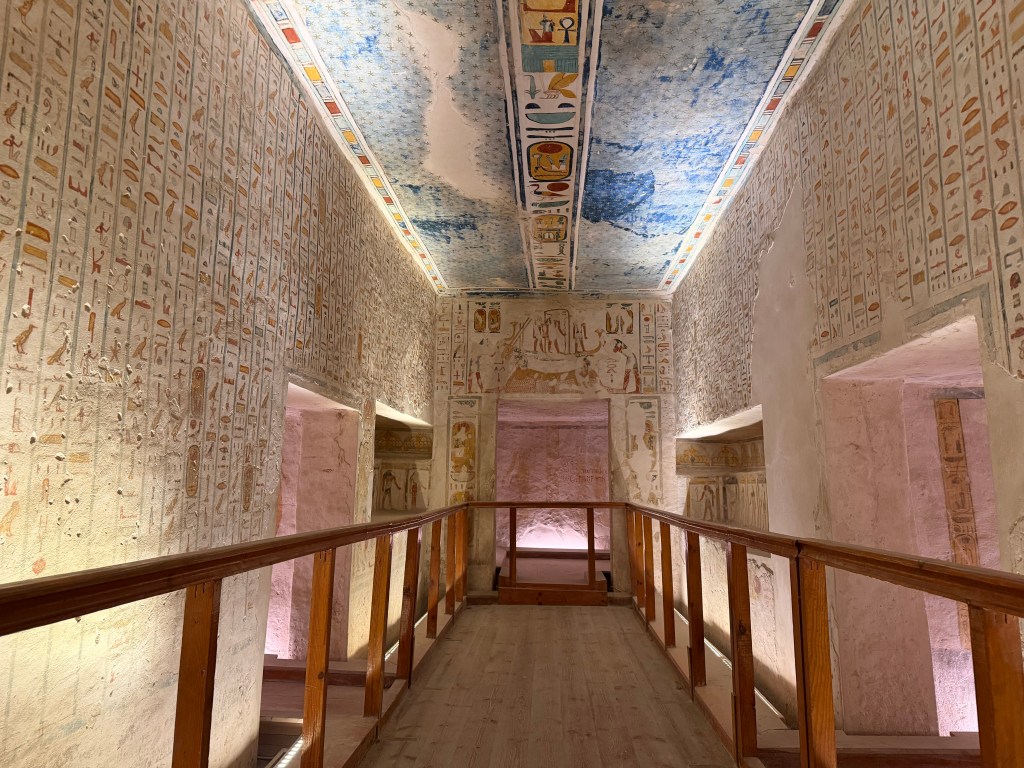
The first tomb we visited was Ramses IV, which featured a long, colorful corridor and a stunning burial chamber decorated with a beautiful night-sky ceiling. Next was Ramses I — short, steep, but unbelievably vivid, with deep blue tones covering the burial chamber. Ramses III was my favorite: long, dramatic, and filled with incredibly detailed carvings and colors that felt almost unreal.
We also visited King Tutankhamun’s tomb, which surprised me by how small it was — just a single chamber. But the wall paintings were stunningly preserved, and the most incredible moment was seeing King Tut’s mummified body on display. It was surreal to realize he has been preserved for thousands of years and still looks so intact.
At one point, King Tut’s tomb was briefly closed for Tiffany Trump’s arrival, and by the time we left, they weren’t allowing any additional visitors in. It was absolute luck that we got to experience it — and I’m so grateful we did.
Alabaster Factory & a Home-Cooked Lunch
Outside of Luxor, we visited an alabaster factory where artisans carve this soft, translucent stone into statues, vases, and decorative pieces. Alabaster has been used in Egypt for thousands of years, prized for its smooth texture and natural glow.
The factory was family-run, and we were shown how each piece is still handmade using traditional tools and techniques. Watching the process gave me a whole new appreciation for the craftsmanship involved. I ended up purchasing a hand-painted hieroglyphic pyramid — a meaningful keepsake knowing exactly where and how it was made.
Afterward, we were welcomed into a local home for lunch, which ended up being one of my favorite meals of the entire trip. We started with a comforting orzo soup, followed by beans, vegetables, chicken, pita, and creamy baba ghanoush. Everything tasted like it came straight from grandma’s kitchen.
Meeting the family who cooked for us made the experience even more special. Knowing that our visit directly supported the local community and provided income for their livelihood made the meal feel that much more meaningful.
Funtasia Program Visit: Community & Creativity
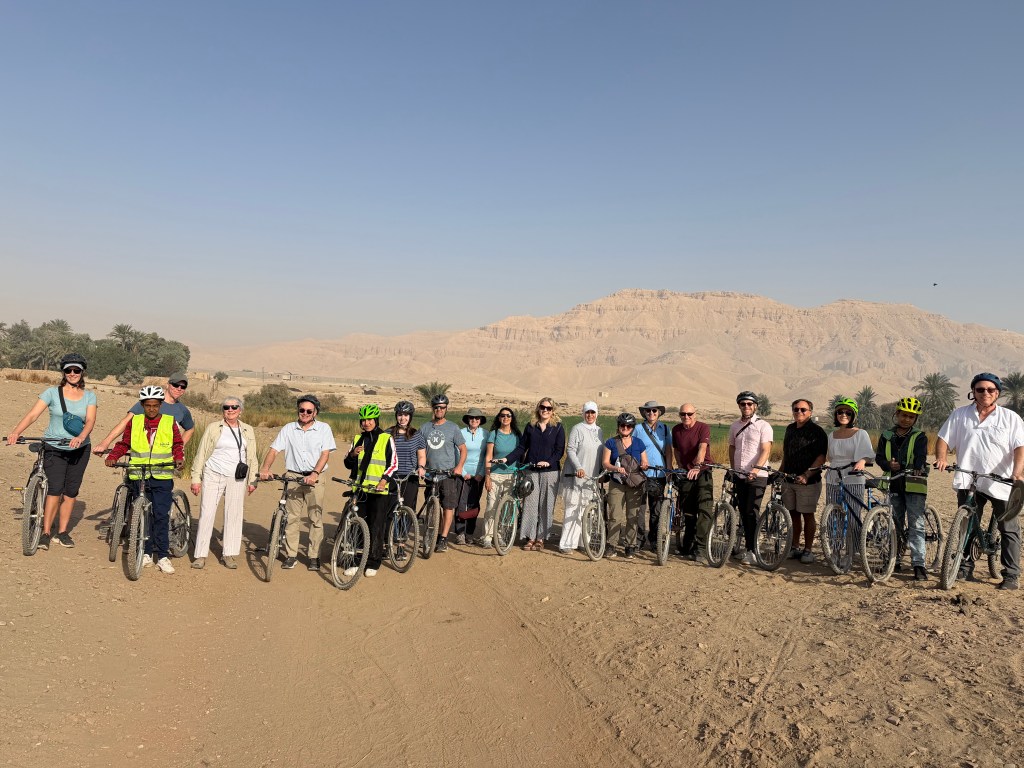
One of the most impactful experiences of the trip was visiting the Funtasia program, part of Plantera, which provides opportunities for children in local communities to learn life skills and express their creativity.
We started with a bike ride through the neighborhood, guided by student leaders from the local middle school. Afterward, we returned to the main building to learn more about the program and explore the community garden. It was inspiring to see how the program empowers kids, builds confidence, and invests directly in the next generation.
Knowing that the money from our visit goes straight back into supporting these communities made the experience feel incredibly meaningful. It was a powerful reminder that travel can go beyond sightseeing — it can also be a way to give back and connect on a deeper level.
Deir el-Medina, Medinet Habu & the Ramesseum: Luxor’s Lesser-Known Treasures
Our last day in Luxor took us off the more crowded paths and into some of the city’s lesser-known, but incredibly rewarding, sites. Visiting Deir el-Medina, Medinet Habu, and the Ramesseum felt like a slower, more intimate way to say goodbye to Luxor — one that focused on color, craftsmanship, and stories often missed.
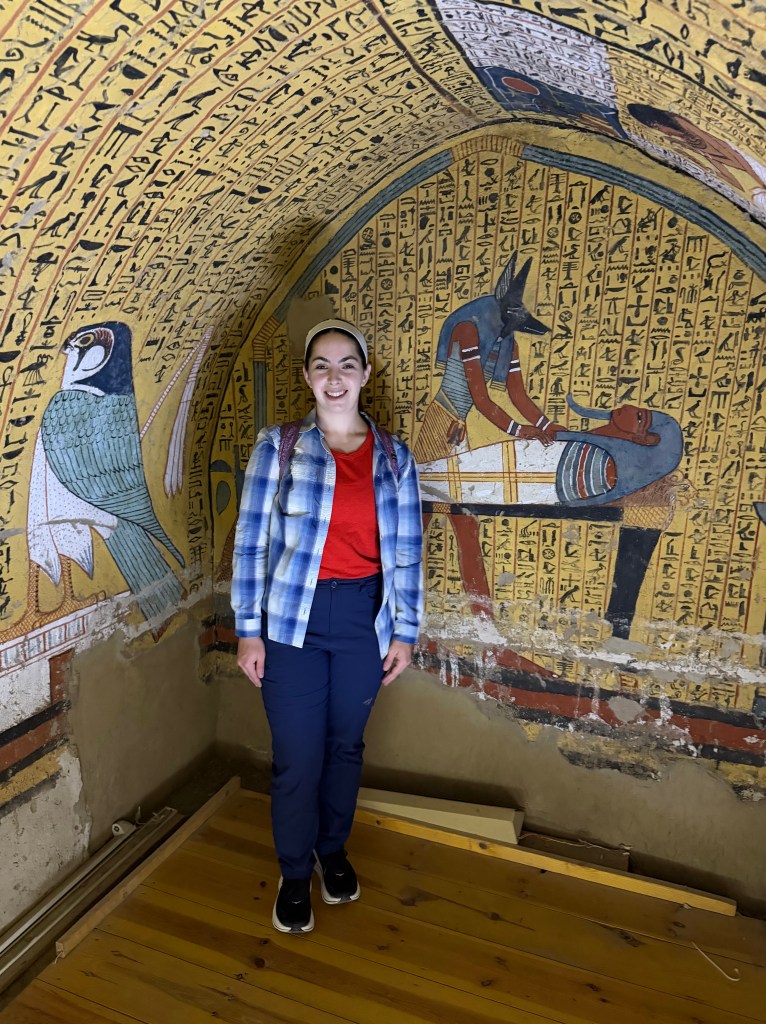
Deir el-Medina, also known as the Workers’ Village and Tombs, was my favorite stop of the day. Tucked away from the main tourist routes, these tombs belonged to the artisans who built the grand royal tombs in the Valley of the Kings. The spaces were small and sometimes difficult to navigate, with low ceilings and narrow passages, but stepping inside felt like discovering something precious. The colors were incredibly vivid, with beautifully preserved scenes and details that felt almost untouched. Without the crowds, it was easy to linger and really take in the artistry — these tombs felt personal, treasured, and deeply human.
Medinet Habu, the mortuary temple of Ramses III, was impressive in a different way. The scale of the temple, combined with its remarkably preserved columns and wall reliefs, made it one of the most visually striking sites we visited. The colors here were still bold and rich, and walking through the massive courtyards felt almost surreal. Despite its grandeur, it was surprisingly calm compared to other major temples, making it easier to appreciate the details and sheer craftsmanship.
The Ramesseum, built as the mortuary temple of Ramses II, carried a quieter sense of awe. The remains of the colossal fallen statue of Ramses II immediately stood out — even destroyed, its size was overwhelming. Scattered throughout the complex were other statues and reliefs, hinting at how monumental this site must have been in its prime. Wandering among the ruins felt reflective, like piecing together fragments of a once-grand vision.
Together, these sites showcased a different side of Luxor — one less about crowds and checklists, and more about discovery, color, and connection to the people and stories behind the monuments. They were the perfect way to end our time in this unforgettable city.
Sailing the Nile: Our River Cruise Experience
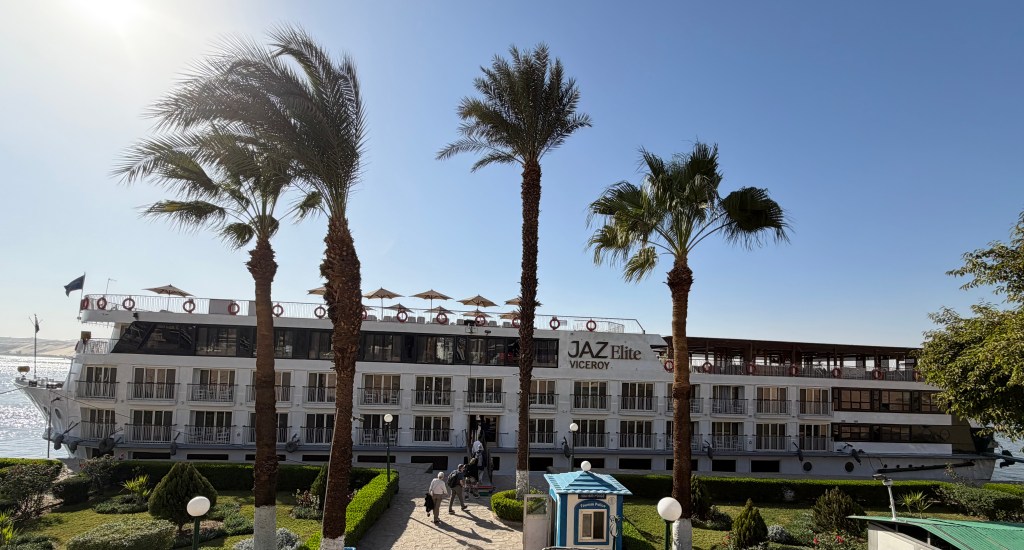
We spent three days cruising along the Nile River from Aswan to Luxor — a classic and essential part of any Egyptian itinerary. Our ship, the Jaz Elite Viceroy, had a capacity of about 70 passengers, though there were only around 50 on our voyage, which made it feel comfortable and relaxed. The ship had four decks, and every room featured a river view and private balcony, which was such a treat.
My room was surprisingly huge, with a king-size bed, sitting area, and plenty of space to unwind. It was quiet, clean, and incredibly comfortable — the perfect place to rest after long days of exploring. Onboard, there was a small shop, a lounge and bar on the top deck, and a pool area with lounge chairs overlooking the river. All meals were served in the main dining room on the first level, where we had breakfast, lunch, and dinner each day.
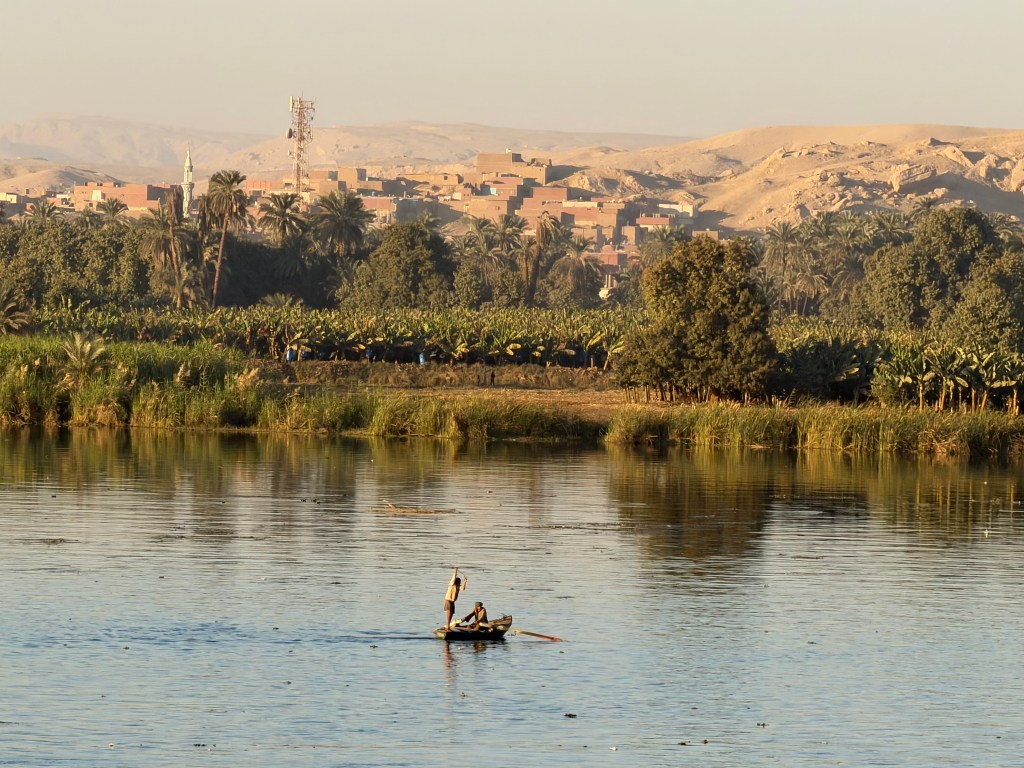
The first full day included our visit to Kom Ombo and then hours of sailing. Watching the Nile pass by felt almost biblical — palm trees lining the banks, endless desert beyond, and scenes that felt untouched for thousands of years. Aside from the occasional cell phone tower in the distance, it felt like stepping back in time. The day was intentionally slow and relaxing, with the river doing most of the work.
One evening, the crew hosted an Egyptian Night, complete with a cocktail party and a traditional buffet. We sampled so many local favorites, including koshary (Egypt’s national dish), kofta, lentil soup, lamb, tahini, baklava, and more. The food was absolutely delicious, and I loved having the chance to experience authentic Egyptian flavors onboard. There were also Egyptian costumes and props for photos, which added a fun and lighthearted touch to the night.
On the second full day, we explored in the morning and then returned to the ship for lunch and some much-needed pool time. I finally worked up the courage to jump in — the pool was freezing, but it was also the hottest day of the trip so far, and it felt incredibly refreshing. Each afternoon, I’d sit back with a bottle of Sakara beer, a crisp local light lager, watching the Nile glide by. It was the perfect way to slow down and soak it all in.

Leave a comment